An MLM company generates thousands of transactions and activities as its network grows. New distributors join, products are sold, orders are processed, commissions are calculated, payouts are made and teams expand across different locations.
The challenge is not collecting this information. The challenge is understanding it.
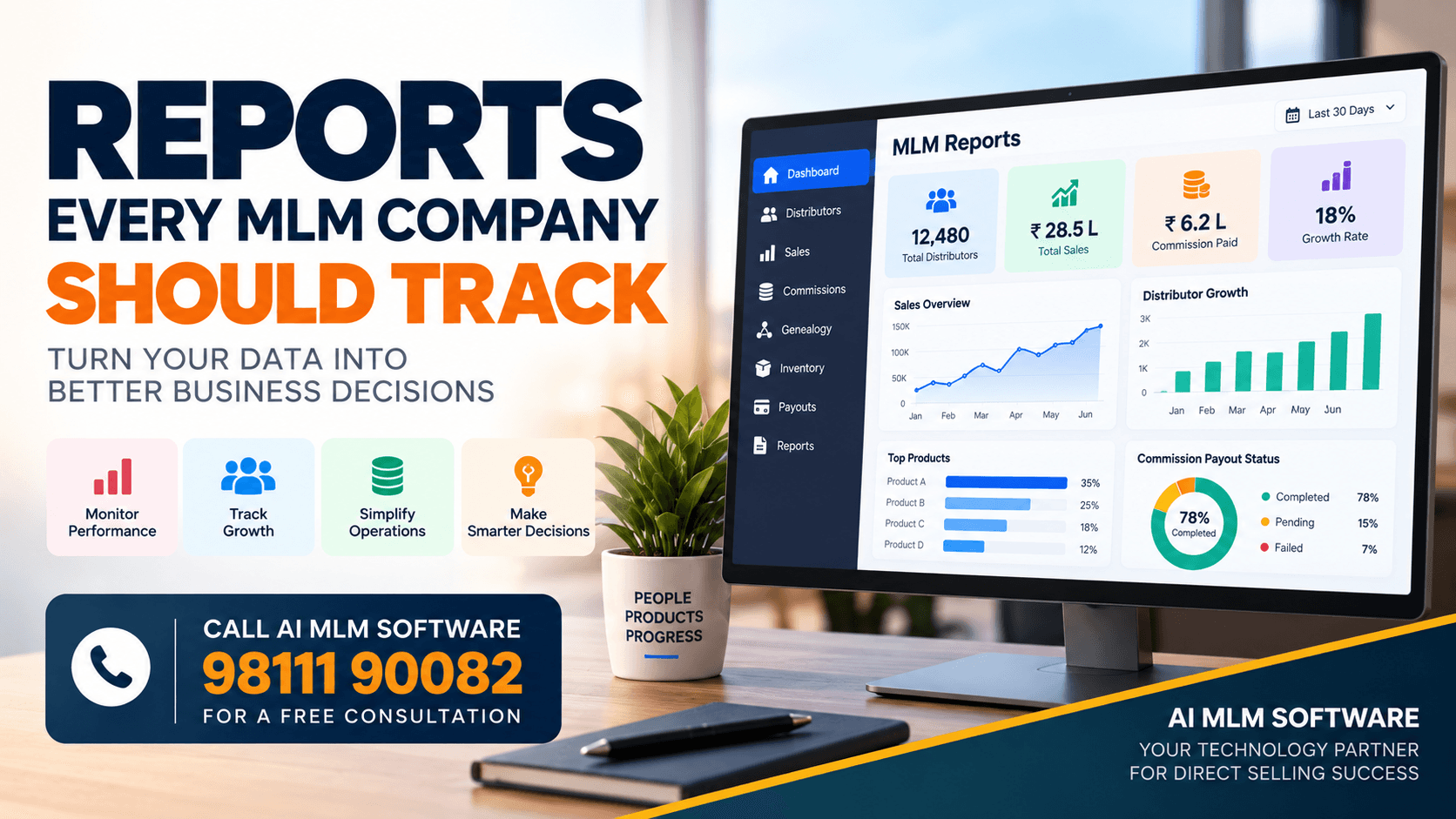
MLM Reports help management turn daily business data into information that can be used for planning, performance monitoring and decision-making. With the right MLM software, companies can bring distributor activity, sales, commissions, inventory, payments and network performance into one reporting system.
For a growing MLM or direct selling company, reporting should not be limited to a monthly sales statement. Management needs a broader view of how the entire network is performing.
Why MLM Companies Need Better Reporting
An MLM business has several interconnected areas. Sales affect commissions, distributor activity affects team performance, product movement affects inventory and payouts depend on accurate commission calculations.
Looking at each area separately can make it difficult to understand the complete picture.
A centralized MLM Reporting Software system can help management monitor important business information from one place. It can also give distributors access to relevant information about their own sales, network, commissions and earnings.
The objective is simple: know what is happening in the business, identify what needs attention and make decisions based on reliable information.
Reports Every MLM Company Should Track
1. Distributor Registration Report
The distributor registration report shows how quickly the network is growing. It provides information about new registrations, activation status, KYC progress and sponsor relationships, helping management understand recruitment activity and identify registrations that have not yet become active.
2. Distributor Performance Report
A distributor performance report provides a clear view of individual contribution to the business. It can help management assess sales activity, team contribution, business volume and earnings to understand which distributors are performing well and where additional support may be required.
3. MLM Sales Report
The MLM Sales Report provides an overview of sales across products, distributors, teams and selected periods. Comparing sales data over time helps management identify revenue trends, strong-performing products and teams that are contributing significantly to overall business performance.
4. Team Performance Report
MLM companies need to understand not only individual performance but also how complete teams are developing. A team performance report provides visibility into team sales, business volume, active members and overall contribution, making it easier for managers to monitor network development.
5. MLM Genealogy Report
The genealogy report provides a structured view of the distributor network. It helps administrators and distributors understand sponsor relationships, uplines, downlines and team structures, making network information easier to review and manage.
6. MLM Commission Report
The MLM Commission Report is particularly important because distributor earnings are directly connected to the compensation plan. It shows how commissions and bonuses have been calculated and can provide details about deductions and payable amounts. Clear commission reporting can improve transparency and reduce questions about distributor earnings.
7. MLM Income and Wallet Report
An income and wallet report gives distributors and administrators a complete view of wallet activity. It can show commission credits, withdrawals, transfers, adjustments and balances, providing a clear transaction history for distributor earnings.
8. MLM Payout Report
The payout report helps finance and administration teams monitor distributor payments. It provides visibility into pending, processed and failed payouts while keeping payment information connected with the relevant distributor and transaction records.
9. Rank and Achievement Report
Rank and achievement reports help companies monitor distributor progress against their compensation or incentive criteria. Management can identify distributors who have achieved particular ranks and those who are progressing toward their next qualification.
10. Product Sales Report
A product sales report shows which products are generating demand across the network. Management can use this information to understand product performance, compare sales periods and make more informed decisions about product planning and sales activities.
11. MLM Inventory Report
The MLM Inventory Report provides visibility into stock levels and product movement. It helps companies monitor inventory across warehouses or locations and identify products that may require replenishment, particularly when sales are increasing.
12. Order Report
An order report brings customer and distributor order information together. It can help teams monitor order status, payment, shipping, cancellations and refunds while providing a clearer view of the complete order process.
13. Customer Report
Customer reports help MLM companies look beyond distributor recruitment and understand actual product demand. Information about customer purchases, purchase history and repeat activity can help management evaluate customer engagement and product performance.
14. KYC and Compliance Report
The KYC and compliance report helps administrators monitor distributor verification from a central location. It provides visibility into pending, approved and rejected applications and makes it easier for teams to follow up on incomplete verification.
15. Recruitment Report
A recruitment report helps management understand how the distributor network is expanding. By reviewing registration and activation trends, companies can evaluate recruitment activity and identify changes in distributor acquisition over time.
16. Repurchase Report
For product-based MLM companies, repurchase activity can provide valuable information about ongoing demand. A repurchase report helps track repeat purchases by distributors and customers and can highlight products with stronger recurring demand.
17. Sales and Commission Report
Connecting sales and commission information gives management a better understanding of how business volume translates into distributor earnings. This report can help companies review compensation-plan performance and identify significant changes in sales or commission costs.
18. MLM Business Dashboard
An MLM Business Dashboard brings important business indicators together in one view. Instead of opening multiple reports, management can monitor sales, distributors, commissions, payouts, inventory, customer activity and network growth through a centralized dashboard.
Which MLM Reports Should Be Reviewed Daily?
Not every report needs to be reviewed every day. The reporting schedule should depend on the size and operating model of the company.
Daily Reports
Sales, orders, payments, inventory, new distributor activity, commissions and KYC status are useful for day-to-day operational monitoring.
Weekly Reports
Distributor performance, team performance, recruitment, product sales, repurchase activity and payout status can help managers review short-term trends.
Monthly Reports
Sales growth, distributor growth, commission analysis, product performance, customer activity, rank achievements and overall business KPIs provide management with a broader view of business performance.
The important point is to create a reporting routine that matches the company's actual business requirements.
Why Real-Time MLM Reports Matter
A report is most useful when the information is available when management needs it.
Waiting until the end of the month to identify falling sales, inactive distributors or low inventory can delay the response. Real-time or frequently updated MLM Analytics can provide earlier visibility into important changes.
For example, management may notice that:
Sales have dropped in a particular region.
A previously active distributor group has slowed down.
A product is selling faster than expected.
Inventory is becoming low.
Commission costs have changed significantly.
New distributor registrations are increasing but activation is falling.
These insights can help management investigate the situation and take appropriate action.
How MLM Software Makes Reporting Easier
Preparing MLM reports manually becomes increasingly difficult as the network expands.
Data may come from distributor registrations, orders, payments, inventory systems, commission calculations and customer transactions. Combining all of this information manually can consume considerable administrative time.
An integrated MLM Software platform can connect these activities and generate reports from the underlying business data.
For example:
Distributor Activity → Sales → Commission → Wallet → Payout → Management Report
When these processes are connected, the same transaction data can support different reports without requiring employees to repeatedly enter or reconcile the information.
AI MLM Software provides MLM business capabilities including compensation plans, distributor management, genealogy, commission and wallet management, reporting, analytics and business automation.
What Should a Good MLM Reporting System Provide?
A good reporting system should not simply produce a large number of reports. The information needs to be useful and easy to understand.
Accurate Information
Reports should be based on reliable distributor, order, payment and commission data.
Easy-to-Understand Reports
Management and distributors should be able to understand the information without needing technical expertise.
Flexible Filtering
Users should be able to view information according to relevant dates, distributors, teams, products, locations or other business parameters.
Role-Based Access
Administrators, managers and distributors should only see the information appropriate to their roles.
Dashboard Visibility
Important KPIs should be available through dashboards so management can quickly review business performance.
Export and Analysis
Where required, reports should be available for further analysis, record keeping or financial reconciliation.
How AI MLM Software Helps Companies Use Their Reports
AI MLM Software is built to support the operational requirements of MLM and direct selling companies, including compensation plans, distributor management, genealogy, commission processing, eCommerce, automation and business reporting.
The advantage is that reporting does not have to operate as a separate function.
Sales information can connect with order management. Order information can connect with inventory. Distributor activity can connect with commissions. Commission information can connect with wallets and payouts.
This creates a more connected reporting environment for management and distributors.
For companies with broader technology requirements, MLM software can also be integrated with ERP, CRM, eCommerce, payment and other business applications. AI MLM Software already provides ERP integration as part of its direct selling technology services.
Reports That Help Different MLM Teams
Different departments may use the same business data for different purposes.
Management can focus on sales growth, distributor activity, team performance, commissions and overall business KPIs.
Finance Teams can focus on commissions, wallets, payouts, deductions and transaction reconciliation.
Sales Teams can monitor distributor performance, recruitment, team sales and product activity.
Inventory Teams can track stock levels, product movement and order demand.
Compliance Teams can monitor KYC verification and distributor documentation.
Distributors can access their personal sales, team performance, commissions, wallet balance and network information.
A centralized reporting system allows each user group to work with the information relevant to its responsibilities.
How MLM Reports Support Better Business Decisions
Reports become valuable when they lead to action.
If a sales report shows declining performance, management can investigate the affected products or teams.
If a distributor report shows declining activity, the company can review engagement and support requirements.
If an inventory report shows increasing demand, stock planning can be adjusted.
If a commission report shows an unexpected increase in payouts, the company can review the underlying sales and compensation calculations.
This is the difference between having business data and using business data effectively.
Final Thoughts
An MLM company generates valuable information every day. The challenge is organizing that information so management, finance teams, sales managers and distributors can actually use it.
The right MLM Reports provide visibility into sales, distributors, genealogy, commissions, payouts, inventory, customers, recruitment and overall network growth.
As the business expands, automated reporting through MLM software can reduce manual work and give management a more consistent view of business performance.
For a growing MLM or direct selling company, reporting should be treated as an important part of the software infrastructure—not simply an administrative task.
Build MLM Software With Powerful Reporting and Analytics
If your company needs MLM Reporting Software with distributor management, compensation plans, genealogy, commission tracking, eWallet, inventory, dashboards and business analytics, AI MLM Software can develop a solution around your business requirements.
Call AI MLM Software at 98111 90082 for a free consultation and discuss your MLM software and reporting requirements.
Also Read: Inventory Management Challenges in Direct Selling: How MLM Software Helps