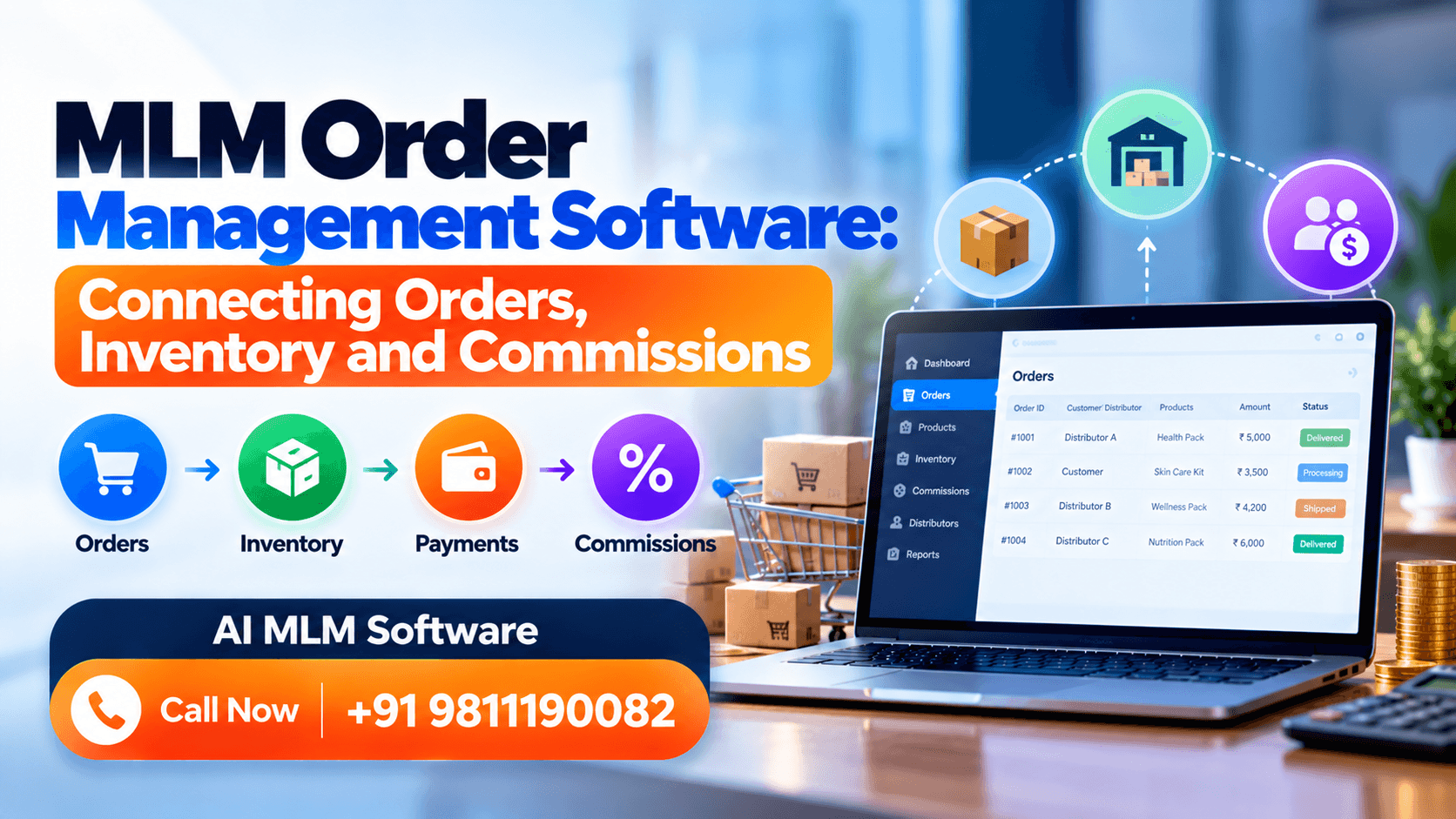
For a direct selling company, an order is not simply a sales transaction. Once a distributor or customer places an order, several business activities may need to happen at the same time. Stock has to be updated, payment needs to be recorded, the correct distributor needs to receive sales credit, and the applicable commission may need to be calculated.
This is where MLM Order Management Software becomes important.
A properly connected order management system brings orders, products, inventory, payments, distributor sales and commission processing into one business workflow. Instead of maintaining separate records across spreadsheets, eCommerce platforms, inventory software and accounting systems, the company can manage the complete order lifecycle through connected software.
For growing direct selling companies, this connection can reduce manual work, improve data accuracy and give management better visibility into sales and inventory.
What Is MLM Order Management Software?
MLM Order Management Software is a business application designed to manage product orders within a Multi-Level Marketing (MLM) or direct selling business while connecting those orders with distributors, customers, inventory, payments and commissions.
Traditional eCommerce order management mainly focuses on selling products and fulfilling customer orders. MLM order management has an additional layer because every sale may have a relationship with a distributor, sponsor, genealogy structure, sales volume and compensation plan.
For example, when a distributor purchases or sells a product, the system may need to identify the distributor, record the order, reduce available stock, process payment, calculate sales volume and send the applicable transaction to the commission engine.
The complete business relationship can therefore look like:
Distributor / Customer → Product Order → Payment → Inventory → Sales Volume → Commission → eWallet → Payout → Reporting
This is what makes MLM order management different from a conventional online store.
Why Order Management Is Important in Direct Selling
As a direct selling company grows, the number of distributors, customers, products and daily transactions also increases. Managing these transactions manually becomes increasingly difficult.
An order may be received through a distributor portal, shopping website, mobile application or other sales channel. If these channels are not connected to the central MLM system, the same information may have to be entered multiple times.
This can result in stock discrepancies, incorrect distributor attribution, delayed commission calculations and additional reconciliation work.
With connected MLM Order Management Software, the same order can move through the required business processes without repeatedly entering the same information.
The objective is not simply to process orders faster. It is to ensure that the order remains connected to every business activity that depends on it.
How MLM Order Management Connects Orders, Inventory and Commissions
The most important advantage of an integrated order management system is the connection between different business functions.
A typical direct selling transaction can follow this workflow:
Product Selection → Order Creation → Payment → Order Confirmation → Inventory Update → Sales Volume → Commission Calculation → eWallet Credit → Payout → Reporting
Each stage depends on the information generated by the previous stage.
For example, when an order is confirmed, inventory should reflect the sale. The system should then determine whether the transaction contributes to the distributor's sales volume and whether it qualifies for a particular commission according to the company's compensation plan.
This creates a connected transaction rather than a collection of independent records.
MLM Order Management and Inventory Management
Inventory is one of the area’s most directly affected by order processing.
When an order is confirmed, the software should be able to update available stock according to the company's inventory rules. This becomes especially important for companies operating multiple warehouses, product categories, regional distribution centres or large distributor networks.
A connected inventory workflow may look like:
Customer Order → Stock Check → Warehouse Allocation → Order Confirmation → Inventory Deduction → Shipment → Delivery
If inventory and order management are maintained separately, the company may have to reconcile sales records with stock records manually.
With integrated MLM Inventory Management Software, management can obtain better visibility into available stock, products sold, pending orders, warehouse inventory and product movement.
For businesses with multiple warehouses, the system can also be designed around location-specific inventory and fulfilment rules.
Connecting eCommerce with MLM Order Management
Many direct selling businesses operate an online shopping portal where distributors and customers can purchase products.
The eCommerce platform therefore needs to communicate with the MLM system.
The connection can be represented simply as:
eCommerce → Inventory
eCommerce → Payment
eCommerce → MLM
MLM → Commission
MLM → eWallet
Inventory → ERP
In a properly integrated architecture, an order placed through the shopping portal does not remain isolated inside the eCommerce system.
The order can be transferred to the MLM platform, payment status can be verified, inventory can be updated and distributor attribution can be maintained. Where the transaction qualifies under the compensation plan, the appropriate sales and commission records can also be generated.
This is particularly useful when a company operates both distributor sales and customer-facing eCommerce.
Distributor Order Management
Distributor orders require more information than a normal customer order.
The system may need to identify the distributor, sponsor relationship, customer, product, quantity, price, payment status and sales volume associated with the transaction.
For example:
Distributor → Product → Order → Payment → Sales Volume → Commission → eWallet
This allows the company to maintain a relationship between the product sale and the distributor who generated or owns the transaction.
A well-designed distributor order management system can also provide order history, order status, invoices, payment records, shipment information and commission-related transaction details through the distributor dashboard or mobile application.
Order Management and MLM Commission Calculation
Commission processing is one of the most important reasons why MLM order management cannot be treated as ordinary eCommerce software.
Depending on the compensation plan, a product order may contribute to personal sales, group sales, points, business volume or other qualification criteria.
The order therefore becomes an input for the commission engine.
A simplified flow is:
Product Sale → Sales Volume → Compensation Rules → Commission Calculation → eWallet → Payout
The exact calculation depends on the company's compensation plan. Binary, Matrix, Unilevel, Generation and Hybrid plans can have different rules for determining eligibility and commission amounts.
For this reason, the order management system should be designed together with the compensation plan rather than treated as an independent eCommerce module.
Payment Gateway Integration
Payment processing is another important part of the order lifecycle.
An MLM order management platform may need to connect with payment gateways, banking systems, wallets or other payment services.
The basic relationship is:
Order → Payment Gateway → Payment Confirmation → Order Status → Commission Processing
The system should distinguish between successful, failed, pending, refunded and cancelled transactions.
This is important because commission processing should normally be based on the company's defined payment and order-confirmation rules rather than simply assuming that every order has been successfully paid.
Payment integration can also reduce manual reconciliation between order records and payment records.
Returns, Refunds and Order Adjustments
Order management does not end when a payment is received.
Direct selling companies also have to manage cancellations, returns, refunds, replacements and other order adjustments.
This can become particularly important when an order has already contributed to distributor sales volume or commission calculations.
For example:
Order → Commission → Return → Commission Adjustment → eWallet Adjustment
The exact treatment depends on the company's compensation and refund policies.
A properly designed system should therefore maintain transaction history so that changes can be traced and appropriate adjustments can be processed without manually editing financial records.
MLM Order Management with Enterprise Resource Planning Integration
Larger direct selling companies may use Enterprise Resource Planning (ERP) software for finance, accounting, procurement, inventory or other enterprise operations.
MLM software does not necessarily have to replace the ERP system.
Instead, both systems can be connected.
MLM Software → Order → ERP → Inventory & Accounts
ERP → Inventory → MLM Software
Payment → ERP → Financial Records
This type of integration can help keep operational and financial information synchronized.
For example, the MLM platform may manage distributors, genealogy and commissions while the ERP system manages accounting, procurement and broader inventory operations.
Customer Relationship Management Integration
Customer Relationship Management (CRM) software can also be connected with MLM order management.
CRM systems can manage leads, customer interactions, follow-ups and sales activities, while the MLM platform manages distributor relationships, genealogy and compensation.
A connected workflow may look like:
Lead → CRM → Distributor → Product → Order → Payment → Commission → Dashboard
This creates a more complete view of the customer and distributor journey.
It also allows sales teams to work with customer information without repeatedly entering order information into multiple systems.
Application Programming Interface Integration
Application Programming Interface (API) integration is commonly used when different software systems need to exchange information.
For an MLM business, APIs can connect order management with payment gateways, eCommerce platforms, CRM, ERP, accounting systems, mobile applications, communication platforms and other business applications.
For example:
Mobile App → API → MLM Software → Order Management → Inventory → Commission
The exact integration architecture depends on the company's existing systems, transaction volume, security requirements and business processes.
MLM Order Management Through Mobile Applications
Distributors increasingly expect to manage their business through mobile devices.
A distributor mobile application can provide access to orders, products, customer information, sales, commissions, wallet balances and reports.
A connected mobile workflow can be represented as:
Mobile App → Product Catalogue → Order → Payment → Order Status → Commission → eWallet
This gives distributors greater visibility into their transactions while reducing dependency on back-office teams for routine information.
For companies with large distributor networks, mobile order management can become an important part of the overall sales infrastructure.
Reports and Business Visibility
Order management software should not only record transactions. It should also turn those transactions into useful business information.
Management may need to understand which products are selling, which distributors are generating orders, where inventory is moving, which orders are pending and how sales are affecting commissions.
Important reporting areas can include:
Order and sales reports
Product and inventory reports
Distributor sales reports
Commission reports
Payment and reconciliation reports
Returns and refund reports
Warehouse and fulfilment reports
These reports can also feed into Business Intelligence dashboards for management-level analysis.
How AI MLM Software Makes Order Management More Effective
AI MLM Software, developed by Vista Neotech Pvt. Ltd., focuses on connecting the operational parts of a direct selling business rather than treating order processing as an isolated function.
The platform can be designed around the company's compensation plan, distributor structure, products, eCommerce requirements, inventory workflow, payment processing and reporting requirements.
The wider technology architecture can connect:
Distributor Management → Genealogy → Products → Orders → Inventory → Payments → Commission → eWallet → Reporting
This approach allows the order management process to fit the actual business model.
AI MLM Software also supports integration with eCommerce, payment gateways, inventory systems, Customer Relationship Management (CRM), Enterprise Resource Planning (ERP), mobile applications and Application Programming Interfaces (APIs), depending on the project requirements.
Custom MLM Order Management Software vs Separate Systems
Some businesses use separate applications for eCommerce, inventory, payments and MLM commissions.
This approach can work at an early stage, but as transaction volume grows, maintaining connections between separate systems can become increasingly complicated.
A custom MLM Order Management Software solution can instead be designed around the company's complete workflow.
For example:
Customer → eCommerce → Order → Payment → Inventory → Distributor → Commission → eWallet → Accounting
The advantage is not simply having more software features. The real advantage is that the software architecture reflects how the business actually operates.
Who Needs MLM Order Management Software?
MLM Order Management Software can be particularly useful for direct selling businesses that sell physical products through distributors, customers, eCommerce websites or mobile applications.
It becomes more valuable when the business has a large product catalogue, multiple warehouses, growing distributor activity, multiple payment channels or a compensation plan that depends on product sales.
Companies expanding into multiple regions may also require multi-currency, multi-warehouse, tax, payment and localisation capabilities.
Key Benefits of Connected MLM Order Management
A connected order management platform can provide several practical business benefits.
Faster Order Processing: Orders can move automatically between sales, payment, inventory and fulfilment stages.
Better Inventory Control: Stock movements can be linked directly with confirmed orders.
More Accurate Commission Processing: Sales transactions can be connected with compensation rules.
Reduced Manual Data Entry: The same transaction does not need to be repeatedly entered into different systems.
Better Distributor Visibility: Distributors can view their orders, sales, commissions and wallet transactions.
Improved Management Reporting: Business leaders can analyse sales, inventory, orders and commissions from connected data.
Easier System Integration: APIs can connect the MLM platform with eCommerce, CRM, ERP, payment and other applications.
Common Problems When Order Management Is Not Integrated
Disconnected systems often create operational problems as the business grows.
An order may be visible in the eCommerce system but not immediately reflected in inventory. Payment information may be maintained separately. Distributor attribution may require manual verification, while commission calculations may depend on another database.
This can result in:
Order Data → Duplicate Entry → Inventory Mismatch → Payment Reconciliation → Commission Queries → Manual Correction
The larger the transaction volume, the more difficult these problems become to manage manually.
Integrated order management addresses the underlying connection between these systems instead of simply adding another reporting layer.
MLM Order Management Software Implementation
Implementation should begin with understanding the actual business workflow.
The development team should first study the product catalogue, distributor structure, compensation plan, order lifecycle, inventory requirements, payment methods and existing software.
A typical implementation can follow:
Business Requirements → Order Workflow → Compensation Plan → System Architecture → Development → Integrations → Data Migration → Testing → User Acceptance Testing → Go-Live
Testing is particularly important because an order may affect several systems simultaneously.
A test should therefore not stop at checking whether an order was successfully created. The complete transaction should be verified from order creation through inventory, payment, commission, wallet and reporting.
Why Choose AI MLM Software for Custom Order Management?
AI MLM Software is backed by Vista Neotech Pvt. Ltd., with experience in MLM software development, direct selling technology and business software development.
The approach is based on understanding the company's business model first and then designing the software around its operational requirements.
Depending on the project, the solution can include MLM software development, compensation plan implementation, eCommerce and shopping portal development, inventory management, payment integration, mobile applications, CRM and ERP integration, APIs, reporting and business automation.
The objective is to create an order management environment where distributors, customers, products, inventory, payments and commissions work as connected parts of the same business system.
Final Thoughts
For a growing direct selling company, order management is closely connected with almost every important operational function.
An order can affect inventory, payment records, distributor sales, compensation calculations, eWallet transactions, fulfilment and management reporting. Managing these activities separately can create unnecessary manual work and reconciliation problems.
MLM Order Management Software provides a way to connect these processes into a single business workflow.
The ideal architecture depends on the company's compensation plan, product structure, distributor network, eCommerce requirements, inventory model, payment systems and existing technology environment.
When these requirements are properly understood before development, order management becomes more than an order-processing module. It becomes part of the core technology infrastructure of the direct selling business.
Need MLM Order Management Software?
If your direct selling business is dealing with disconnected orders, inventory, payments and commission records, it may be time to connect the complete workflow.
Talk to AI MLM Software about custom MLM Order Management Software, eCommerce, inventory integration, payment processing, commission calculation, Enterprise Resource Planning (ERP) integration and distributor mobile applications.
Call Now: +91 98111 90082