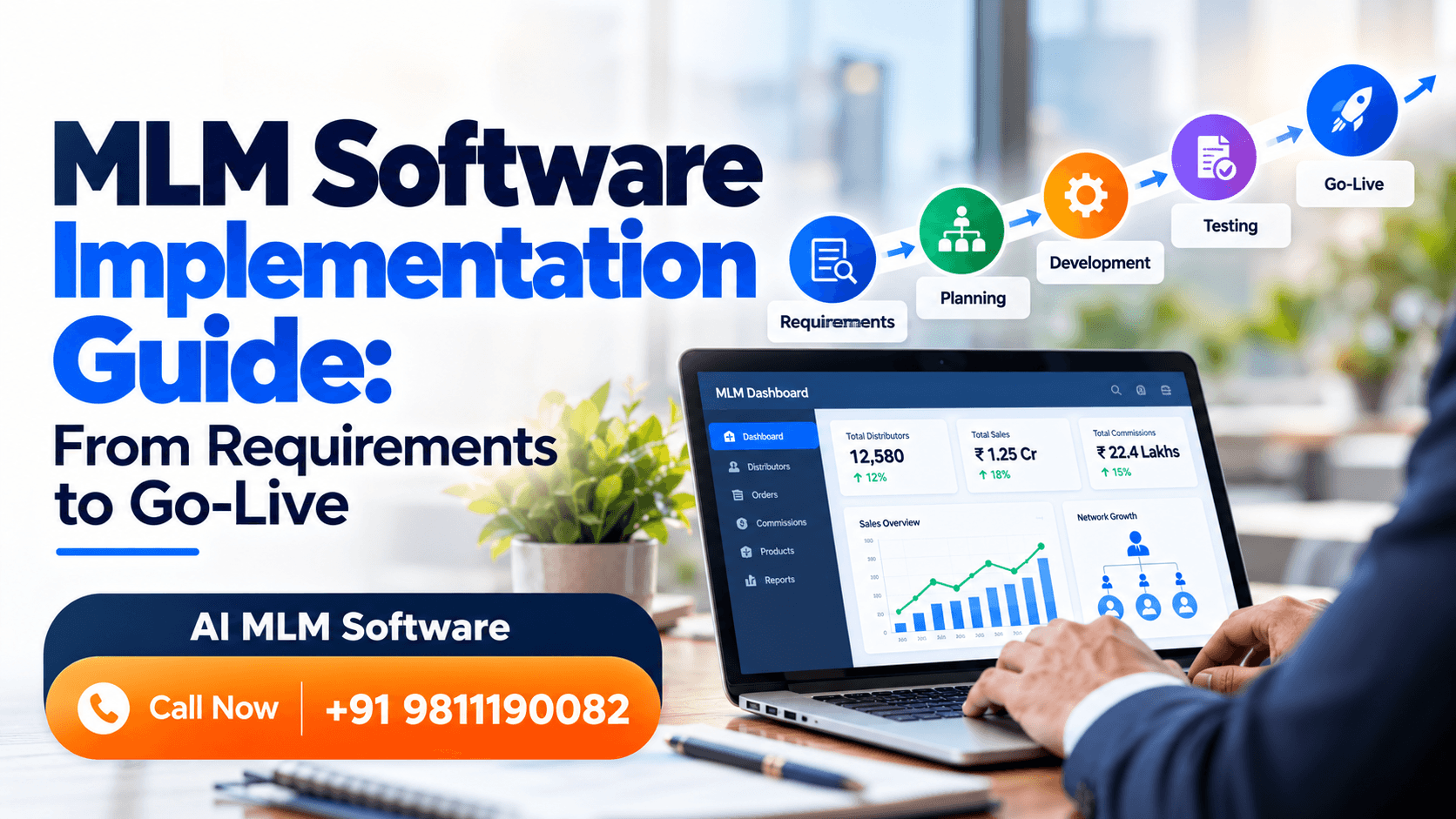
Choosing MLM software is only the beginning of building a technology platform for a direct selling business.
The real challenge starts when the software has to be configured around the company's compensation plan, distributor structure, products, orders, payments, commissions, inventory, CRM, ERP, mobile applications and reporting requirements.
This is where MLM Software Implementation becomes important.
A properly planned implementation takes the business from initial requirements through development, integration, testing, data migration, training and finally production launch. The objective is not simply to install software, but to create a system that correctly reflects how the company operates.
A typical implementation journey looks like:
Business Requirements → Compensation Plan → Architecture → Development → Integration → Data Migration → Testing → UAT → Training → Go-Live → Support
AI MLM Software's current service approach similarly covers planning, design, development, deployment and ongoing optimization for direct selling technology.
What Is MLM Software Implementation?
MLM Software Implementation is the process of planning, configuring, developing, integrating, testing and launching MLM software according to the actual requirements of a direct selling business.
It is much more than installing an application.
For an MLM company, software implementation may involve the complete business journey from distributor registration to commission payout.
For example:
Distributor Registration → KYC → Approval → Product Order → Payment → Inventory → Commission → eWallet → Payout → Reporting
Every stage needs to work correctly with the others.
This is why successful implementation starts with understanding the business rules before technical development begins.
Why MLM Software Implementation Requires Careful Planning
MLM software is different from many ordinary business applications because it combines distributor relationships, sales transactions and compensation calculations.
A single transaction can affect several areas of the system.
Consider a distributor purchasing a product. That order may update inventory, create a payment transaction, generate sales volume, affect the distributor's qualification and eventually create a commission.
The flow may therefore look like:
Product Sale → Sales Volume → Commission Calculation → eWallet → Payout → Financial Report
If the original business rules are not properly understood, errors can appear later in commissions, genealogy, reports or payouts.
Good implementation therefore begins with the business process, not the software menu.
Step 1: Understand the Business Requirements
The first stage is to understand how the direct selling company actually operates.
Before development begins, the software team needs to understand the company's products, customers, distributors, sales process, compensation structure, payment methods and reporting requirements.
The important questions are not simply "What features do you want?"
The better question is:
"How does your business work today, and how should it work after implementation?"
This discussion normally covers distributor registration, sponsorship, placement, products, orders, payments, commissions, returns, refunds, inventory, customer management and management reporting.
Existing systems also need to be reviewed. A company may already have an ERP, CRM, accounting application, eCommerce website or mobile application that needs to remain connected to the new MLM platform.
The result should be a clear MLM Software Requirements Document that becomes the reference point for development and testing.
Step 2: Define the Compensation Plan Before Development
The compensation plan is at the heart of MLM software.
Before development begins, the commission rules should be clearly documented and converted into software requirements.
For example, the implementation team needs to understand how personal sales, group sales, ranks, bonuses, qualification requirements and commission limits work.
It should also be clear what happens when an order is cancelled, returned or refunded.
The basic relationship can be represented as:
Sales → Qualification → Commission Rules → Bonus Calculation → Wallet → Payout
AI MLM Software currently supports different compensation structures including Binary, Board, Hybrid, Unilevel, Differential, Repurchase, Stair-Step/Orbit and Single Leg plans, as well as customized compensation structures.
For a customized compensation plan, this stage becomes particularly important because the development team needs to understand the exact business logic before writing the commission engine.
Step 3: Plan the MLM Software Architecture
Once business requirements are clear, the technology architecture can be planned.
A modern MLM platform rarely operates as a completely isolated system. It may need to communicate with an ERP, CRM, eCommerce platform, payment gateway, KYC service, accounting system, mobile application and analytics platform.
A typical structure can look like:
Web / Mobile → API Layer → MLM Business Engine → Database
with connections to:
CRM | ERP | eCommerce | Payments | KYC | eWallet | Analytics
The architecture should also consider the expected number of distributors, transaction volume, reporting requirements, security and future expansion.
A startup with a few thousand distributors may have very different infrastructure requirements from an international company operating across multiple markets.
Step 4: Decide Which MLM Modules Are Required
Not every direct selling company needs exactly the same system.
The implementation should therefore be based on the company's actual operations.
A typical platform may include distributor management, genealogy, compensation, products, orders, eWallet, CRM, reporting and administration. Depending on the business, it may also include eCommerce, mobile apps, KYC, ERP integration and payment integrations.
The important point is that these modules should not be developed as disconnected features.
They should work together as one business process.
For example:
Distributor → Product → Order → Payment → Commission → Wallet → Report
That connected workflow is much more important than simply having a long list of software features.
Step 5: Plan Integrations Before Development
Integrations should be considered during the planning stage rather than after the core MLM software has already been developed.
For example, if the company uses an ERP for accounting and inventory, the MLM software may need to send order information to the ERP and receive inventory or financial information back.
Similarly, a payment integration may need to confirm successful payment before an order is considered complete.
A typical transaction may therefore move through:
Order Created → Payment Confirmed → Inventory Updated → Commission Calculated → Wallet Updated → Report Updated
AI MLM Software's existing ERP guidance also emphasizes understanding the complete business workflow before designing the integration because payment, commission, product, refund and tax processes can differ from one company to another.
Step 6: Plan Existing Data Migration
For a new MLM company, implementation may start with fresh data.
For an established company replacing an old MLM system, the situation is different.
Existing distributor accounts, sponsor relationships, genealogy, orders, commissions, wallet balances and transaction history may need to be moved into the new platform.
The important point is that data migration is not simply copying one database into another.
The old and new systems may use different database structures, identifiers and business rules.
A safer process is:
Existing Data → Mapping → Cleaning → Transformation → Migration → Validation
The migrated information should then be compared with the original system before the new platform becomes the primary production system.
The detailed subject of legacy MLM migration can remain covered by your existing migration article; this implementation article only needs to explain where migration fits into the overall project.
Step 7: Develop and Configure the MLM Platform
After requirements and architecture are approved, development begins.
For a custom MLM platform, development may progress through the core business engine, distributor management, genealogy, compensation, products, orders, eWallet, reports and integrations.
The development should ideally be reviewed in stages rather than waiting until the entire project is finished.
This allows the business team to verify important workflows early.
For example, management can review the distributor structure and commission calculations before the project moves into the final testing phase.
This reduces the risk of discovering fundamental business-rule differences just before launch.
Step 8: Test the Compensation and Commission System
Commission testing deserves special attention because an incorrect calculation can affect many distributors.
Testing should use realistic business scenarios rather than only simple sample transactions.
For example, the team should verify what happens when several distributors generate sales, reach different ranks, qualify or fail to qualify, receive bonuses, return products or have commissions adjusted.
The important question is not:
"Does the commission screen open?"
The important question is:
"Does the system calculate the correct result according to the company's compensation rules?"
This distinction is critical in MLM software implementation.
Step 9: Test the Complete Business Workflow
After individual modules have been tested, the complete business journey should also be tested.
For example:
Registration → KYC → Approval → Product Selection → Order → Payment → Inventory → Commission → eWallet → Payout → Reporting
This type of end-to-end testing can reveal problems that are not visible when modules are tested separately.
A payment may work correctly on its own, and commission calculation may also work correctly on its own, but the complete transaction still needs to be tested from beginning to end.
Step 10: User Acceptance Testing
Once technical testing is complete, actual business users should test the system.
This is generally referred to as User Acceptance Testing or UAT.
Management can verify reports and dashboards. Finance can verify commissions and payouts. Operations can test orders and inventory. Customer support can test customer and distributor workflows.
Selected distributors can also test the actual distributor experience.
The purpose is simple:
Does the software work according to the business requirements?
Any important issue discovered during UAT should be resolved and retested before production launch.
Step 11: Train the Team Before Go-Live
Software can be technically ready while the organization is still unprepared to use it.
Training should therefore be part of the implementation plan.
Administrators need to understand system configuration and controls. Finance teams need to understand commissions and payouts. Operations teams need to understand products, orders and customers.
Distributors may need training on genealogy, products, orders, commissions, eWallets and mobile applications.
AI MLM Software includes support and training within its broader direct-selling technology offering.
The objective is to ensure that users understand not only where to click, but also how the new system fits into their daily business process.
Step 12: Prepare for Go-Live
Before moving to production, the implementation team should conduct a final readiness review.
The production database, APIs, payment systems, security settings, backups, domains, SSL and monitoring should be checked.
At the same time, the business team should verify products, distributor data, compensation rules, reports and user access.
For an existing MLM company, the final data migration and cutover process should also be clearly defined.
A successful go-live depends on both technical readiness and business readiness.
Step 13: MLM Software Go-Live
Go-live is the point at which the approved MLM platform begins handling actual business transactions.
For a new company, this may be the first production launch.
For an established company, it may mean moving from an older system to the new platform.
A controlled transition can be particularly important for an existing business.
The process may look like:
Old System → Final Data Validation → Migration → Production Activation → Transaction Monitoring
The exact cutover strategy depends on the size and nature of the business.
What Happens After MLM Software Goes Live?
Go-live should not be treated as the end of the project.
Once real users begin working on the platform, new operational information becomes available.
The technical team may need to monitor database performance, API responses, payment transactions, commission processing, mobile applications and system errors.
The business may also request adjustments after seeing the system in real-world operation.
This is why ongoing support, maintenance and optimization are important parts of an MLM technology platform.
AI MLM Software describes its process as continuing beyond deployment through optimization, upgrades and analytics.
How Long Does MLM Software Implementation Take?
There is no single implementation timeline that applies to every direct selling company.
A relatively simple implementation with limited customization can be very different from an international platform requiring custom compensation, eCommerce, ERP, CRM, mobile applications, payment gateways, KYC and data migration.
The timeline is normally influenced by the scope of development, compensation complexity, integrations, existing data, testing requirements and the number of business users involved.
Therefore, it is better to establish the implementation timeline after requirements and project scope have been properly documented rather than promising a fixed number of days before understanding the project.
How Much Does MLM Software Implementation Cost?
The MLM Software Implementation Cost depends on what the company needs to implement.
A new MLM company may require complete software development, while an established company may already have a platform and only need migration, integration or modernization.
The major cost drivers are the complexity of the compensation plan, number of modules, integrations, data migration, mobile applications, eCommerce, reporting, security and infrastructure.
For this reason, an accurate implementation estimate should follow a requirements discussion rather than being based on a generic package price.
Common MLM Software Implementation Mistakes
One common mistake is beginning development before the compensation plan has been properly documented. If commission rules change later, several parts of the system may need to be redesigned.
Another problem is treating data migration as a simple technical exercise. Distributor genealogy, wallet balances and historical transactions need careful validation because they represent actual business records.
Some companies also postpone integration planning. When ERP, CRM, payment or eCommerce requirements are discovered late, the original architecture may need to be changed.
Testing only individual modules is another risk. MLM software should also be tested through complete business workflows, particularly where orders, payments, commissions and payouts are connected.
Finally, companies sometimes treat go-live as the end of the project. In reality, the first weeks of production provide important information about system performance, user behaviour and areas requiring refinement.
MLM Software Implementation Checklist
A concise implementation checklist can help management track project readiness:
Area
What Should Be Confirmed
Business Requirements
Business workflows documented and approved
Compensation
Commission and qualification rules tested
Genealogy
Sponsorship and placement rules verified
Integrations
ERP, CRM, payments and other APIs tested
Data
Migration completed and validated
Orders
Complete order lifecycle tested
Wallet
Credits, debits and withdrawals verified
Reports
Management and operational reports approved
Security
User access and security controls reviewed
UAT
Business users have completed acceptance testing
Training
Relevant teams trained
Go-Live
Production environment and backup verified
Support
Post-launch support process established
How AI MLM Software Makes Implementation More Effective
The value of an implementation partner is not simply in writing software.
The partner needs to understand how direct selling businesses operate and then translate those business rules into technology.
AI MLM Software focuses specifically on MLM and direct selling requirements, with services covering custom MLM software, compensation plans, eCommerce, mobile applications, automation, business intelligence, APIs and related integrations.
This allows implementation to be planned around the complete business flow rather than treating each feature as a separate project.
For example:
Business Requirements → Compensation Plan → MLM Platform → eCommerce → Payment → Inventory → Commission → eWallet → CRM → Mobile App → Analytics
Custom Compensation Plans
The compensation structure can be analyzed before development so that qualification, commission and payout rules are reflected correctly in the software.
Connected Business Systems
ERP, CRM, payment gateways, eCommerce systems, KYC services and mobile applications can be considered as part of the overall architecture.
Data Migration
For companies replacing existing MLM software, migration can be included in the implementation plan and validated before production use.
Distributor Experience
Distributor dashboards and mobile applications can connect directly with the MLM platform so that users can access genealogy, orders, commissions, eWallet information and other relevant business information.
Business Reporting
Management dashboards and reports can be designed around the actual KPIs required by the organization rather than relying only on generic reports.
AI MLM Software is part of Vista Neotech Pvt. Ltd., which currently states 25+ years of experience, 3,000+ projects and work across 50+ business verticals.
The Complete MLM Software Implementation Process
A successful implementation can be viewed as one connected journey:
Business Analysis → Requirements → Compensation Plan → Architecture → Development → Integration → Data Migration → Testing → UAT → Training → Go-Live → Support
Each stage has a different purpose, but all of them contribute to the same objective: creating an MLM platform that accurately supports the company's business model.
The most important principle is simple:
Build the software around the business process, rather than forcing the business to work around the software.
Final Thoughts
MLM Software Implementation is not simply a software installation project. It is a business transformation process that connects distributors, products, customers, orders, payments, commissions, inventory, reporting and integrations into one working platform.
The strongest implementations begin with business requirements and compensation rules. They then move through architecture, development, integration, migration, testing and training before reaching go-live.
For an established direct selling company, implementation can also provide an opportunity to replace disconnected systems, modernize outdated processes and create a technology platform that can support future growth.
AI MLM Software can help businesses plan this journey around their actual compensation structure, operational workflows and technology requirements.
Planning Your MLM Software Implementation?
Whether you are launching a new direct selling company, replacing an existing MLM platform or integrating MLM software with ERP, CRM, eCommerce, payments and mobile applications, the implementation should begin with a clear understanding of your business requirements.
Talk to AI MLM Software about your MLM Software Implementation, compensation plan, integrations, migration and go-live requirements.
Call Now: +91 98111 90082