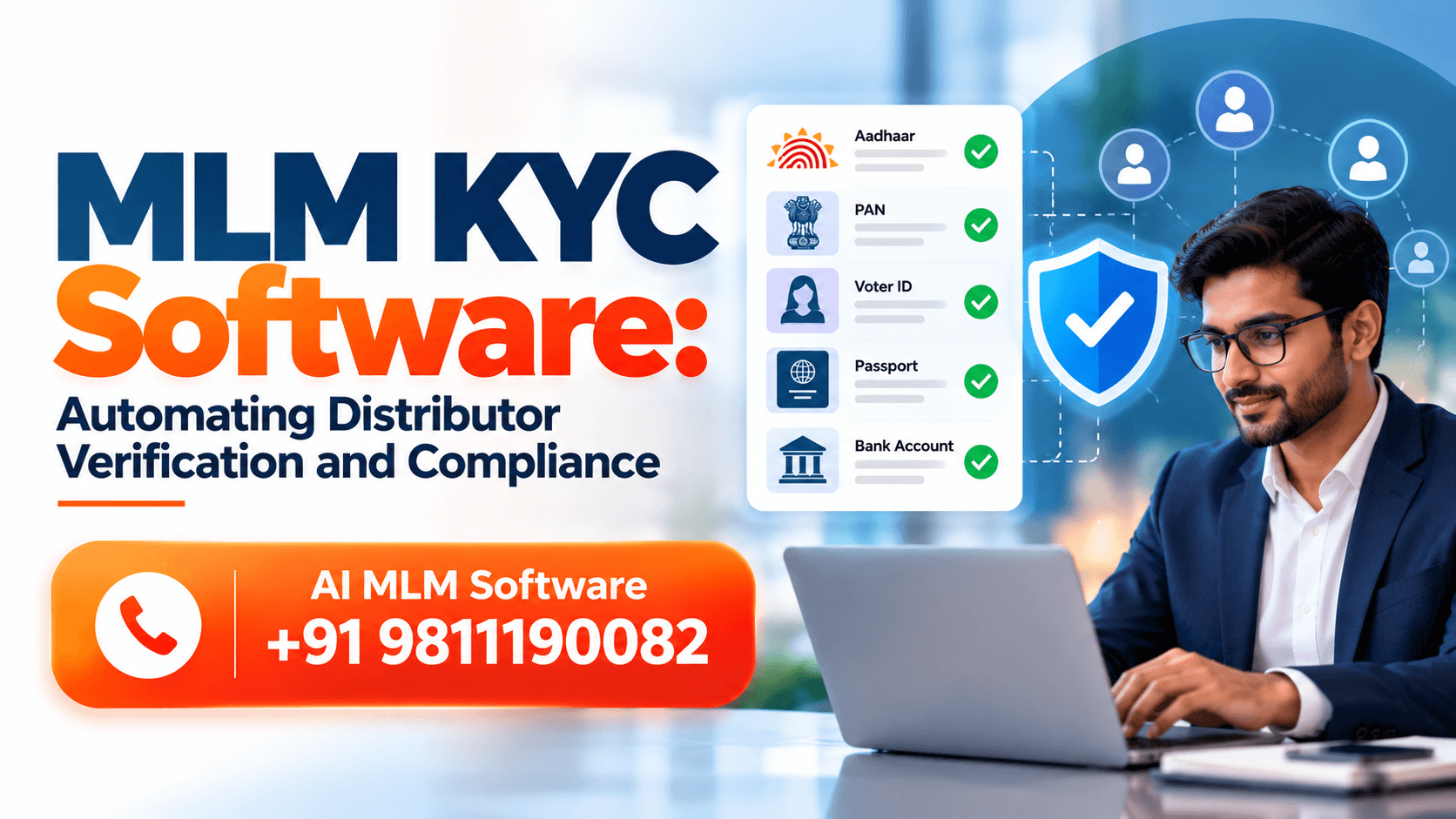
MLM KYC Software helps direct selling companies verify distributor identities, manage Know Your Customer (KYC) documents and organise onboarding records through a structured digital process. As a distributor network grows, verifying every applicant manually becomes time-consuming, difficult to track and more vulnerable to errors.
For a direct selling company, distributor registration is only the beginning. The business may also need to collect identity documents, verify personal details, review applications, approve accounts and maintain records for future reference. These requirements become more challenging when registrations arrive from different locations or through multiple digital channels.
Without a proper verification process, incomplete applications can remain pending, duplicate registrations may go unnoticed, and employees may struggle to identify which records require attention.
MLM KYC Software brings these activities into a more organised workflow. It can connect distributor registration, document collection, identity verification, approval, record management and the wider MLM platform.
For companies planning to launch or expand their direct selling operations, AI MLM Software can help assess how distributor verification should fit into the overall software architecture.
What Is MLM KYC Software?
MLM KYC Software is a digital verification system designed to help Multi-Level Marketing (MLM) and direct selling companies collect, review and manage distributor identity information.
KYC stands for Know Your Customer. Although the term originated in customer verification and financial services, businesses may also use KYC processes to verify distributors, business partners or other participants according to their policies and applicable requirements.
A typical system may collect registration details, identity documents, contact information and other required information. Depending on the selected verification service, it may also support document checks, identity matching and verification status updates.
The important distinction is that collecting a document is not the same as verifying an identity. A well-designed workflow should record whether the required checks were completed, whether further review is needed and whether the application can proceed to approval.
When integrated with MLM software, the verification process can become part of the distributor onboarding journey rather than a separate administrative activity.
Why Direct Selling Companies Need MLM KYC Software
Distributor networks can grow from a small group to thousands of participants. At that scale, spreadsheets, email attachments and manually maintained records can make verification difficult to manage consistently.
A company may receive applications through its website, distributor portal, mobile application or back-office team. If each channel follows a different process, the organisation may end up with inconsistent records and limited visibility into pending applications.
MLM KYC Software provides a central process for managing these applications. The team can see which documents have been submitted, which checks are complete, which applications need additional information and which distributors have been approved.
This is especially useful when verification must be completed before enabling selected account functions, processing certain payments or allowing access to restricted business activities.
The software can also reduce repeated data entry and make it easier to retrieve verification records when authorised staff need to review them.
How MLM KYC Software Works
A practical distributor verification process should be straightforward for applicants and manageable for the company's operations team.
The workflow generally follows:
Distributor Registration → Information Collection → Document Submission → Identity Verification → Review → Approval or Rejection → Record Storage
First, the applicant enters the required registration information. The system then collects the documents or details required by the company's verification policy.
Where a verification provider is integrated, the software can submit the permitted information for the relevant checks and receive a result. Depending on the outcome, the application may be approved, rejected or referred for manual review.
The final decision should follow the company's approved verification rules. A verification service can provide useful evidence, but the company remains responsible for defining its acceptance criteria and handling exceptions appropriately.
Once the process is complete, the system records the status and makes it available to authorised users.
Essential Features of MLM KYC Software
The right features depend on the company's operating markets, distributor onboarding policy and verification requirements. However, several capabilities are particularly useful for direct selling businesses.
1. Digital Distributor Registration
A digital registration form allows distributors to submit the information required during onboarding without relying entirely on paper forms or email exchanges.
The form can be configured to collect personal details, contact information, addresses and other information relevant to the company's policy. Required fields and validation rules can help reduce incomplete submissions.
The registration workflow should also explain which information is required and how it will be used. This helps applicants understand the process before submitting their details.
2. Document Upload and Management
MLM KYC Software can provide a secure way for applicants to submit the required identity documents and supporting records.
The system may record the document type, submission date, verification status and any action required from the applicant. Authorised employees can then review the relevant information without searching through separate email conversations or folders.
Document upload alone does not establish authenticity. Where necessary, additional checks should be performed using suitable verification services or trained reviewers.
3. Automated Identity Verification
Integration with an identity verification provider can reduce the need to review every document manually.
Depending on the provider and the selected service, the process may support document validation, identity detail matching, facial verification or other checks. Availability varies by country, document type and service.
The software can receive verification results and update the application workflow accordingly. Cases that cannot be verified automatically can be directed to an authorised reviewer.
Automation should support consistent processing, not automatically treat every verification result as conclusive proof of identity.
4. Approval and Rejection Workflows
A verification system should make the next action clear.
Applications may be marked as submitted, pending verification, awaiting additional information, under manual review, approved or rejected. The exact statuses should match the company's actual process.
Where an application requires review, the system can assign it to an authorised employee. The reviewer can record the decision and the relevant reason, subject to the company's policies.
This helps management understand where applications are getting delayed and which cases need attention.
5. Verification Status in the Distributor Dashboard
Once integrated with MLM software, verification status can appear in the distributor's account.
Applicants may be able to see whether documents are pending, whether further information is required or whether their application has been approved. This reduces the need for repeated enquiries to the back-office team.
The company can also configure which account functions are available before and after verification, based on its business rules and applicable requirements.
6. Audit Trails and Record Management
A verification record should show what happened during the process.
Useful records may include submission dates, verification results, review actions, approval decisions and relevant status changes. These records help authorised teams understand how a decision was reached.
Audit trails should be protected against unauthorised modification. Access to identity documents and verification results should also be restricted according to the user's role and business need.
Integration of MLM KYC Software with MLM Platforms
KYC becomes more useful when it connects with the main distributor management system.
If verification is handled separately, employees may need to update distributor records manually after an application is approved. This can create delays and inconsistent information.
An integrated system can connect the verification result with the distributor's profile and onboarding status.
A typical workflow looks like:
Distributor Registration → KYC Verification → Approval → Distributor Account Activation → Product Orders → Commission Processing
The company can define which actions are permitted at each stage. For example, an application may be registered before verification is complete, while selected account functions remain restricted until the required checks have passed.
Integration should also account for rejected applications, expired documents, duplicate submissions and cases requiring additional review.
AI MLM Software's published implementation approach covers planning, software development, integrations, testing and deployment. KYC can be evaluated as part of that broader implementation when it is required for the company's business model. Explore the MLM Software Implementation Guide.
KYC API Integration for Distributor Verification
An Application Programming Interface (API) allows MLM software to exchange information with an external identity verification service.
Instead of building every verification capability from scratch, a company can integrate a suitable provider into its onboarding workflow.
The connection may follow:
MLM Registration → Secure API Request → Verification Provider → Result Validation → MLM KYC Status
The exact process depends on the provider's API, supported documents, available checks and commercial terms.
Before choosing a provider, the company should evaluate country coverage, supported identity documents, response times, pricing, data handling, security controls and the procedure for unsuccessful checks.
The integration should transmit only the information necessary for the intended verification. API credentials must be protected, requests should be authenticated and results should be processed through trusted server-side workflows.
Businesses should also consider what happens when the provider is unavailable. A temporary technical failure should not automatically be treated as a failed identity check.
Protecting Distributor Identity Data
KYC information can be highly sensitive. Identity documents, addresses, dates of birth and verification records should not be accessible to every employee or distributor.
Security and privacy therefore need to be part of the software design from the beginning.
Important safeguards include restricted access permissions, secure transmission, appropriate storage protection, audit logging, controlled document downloads and defined retention policies.
The company should also review which records genuinely need to be stored. If a verification provider can return a result or reference that satisfies the business requirement, retaining additional sensitive information may not always be necessary.
Where identity documents must be retained, the company should define how long they are kept, who can access them and how they are securely deleted when retention is no longer justified.
For a platform operating in multiple countries, data handling should be reviewed against the applicable privacy and regulatory requirements.
How MLM KYC Software Helps Reduce Fraud Risks
A structured verification process can help a company identify certain risks during distributor onboarding. These may include incomplete information, duplicate applications, inconsistent identity details or suspicious document submissions.
However, KYC is one part of a broader fraud prevention strategy. It does not guarantee that every applicant is genuine or prevent all future misuse of an account.
A practical system can combine identity verification with appropriate duplicate checks, account security, transaction monitoring and controlled administrative permissions.
For example, the system may flag an application when required details do not match the verification result or when the same identity appears in multiple registrations. The case can then be reviewed according to the company's policy.
The objective is to identify issues early, maintain reliable records and make verification decisions more consistent.
MLM KYC Software and Compliance Management
Compliance requirements vary according to the country, business model, products, payment arrangements and legal status of the organisation. Not every direct selling company has identical verification obligations.
MLM KYC Software can help businesses organise the information and workflow needed to support their internal policies and applicable verification requirements.
For example, the system can record when documents were submitted, whether required checks were completed, who reviewed an application and what decision was recorded.
This makes it easier to retrieve information when authorised staff need to review a case or investigate a discrepancy.
For companies operating in India, the Digital Personal Data Protection Act, 2023, and applicable rules and commencement notifications should be assessed with qualified legal counsel where personal data is involved. Other legal or sector-specific requirements may apply depending on the business.
Software supports compliance processes, but it does not guarantee legal compliance. Companies must establish appropriate policies, determine their obligations and ensure that their actual practices meet the applicable requirements.
Manual KYC vs Automated MLM KYC Software
Manual verification may be manageable when a business receives only a small number of applications. As registration volumes increase, the process can become more difficult to track.
Area | Manual verification | Automated MLM KYC workflow |
Document collection | Email, paper or separate uploads | Centralised digital submission |
Status tracking | Manual updates and follow-ups | Recorded application status |
Verification | Staff-led review | Integrated checks where supported, with manual review when needed |
Application routing | Employees assign cases manually | Configurable workflows and assignments |
Record retrieval | Searching separate files | Organised records with controlled access |
Reporting | Manual compilation | Status and activity reports from recorded data |
Integration | Repeated updates across systems | Can connect verification status to distributor records |
Automation does not remove the need for human judgement. Its value lies in handling repeatable steps, keeping records organised and directing exceptions to the right person.
How to Choose the Right MLM KYC Software
Choosing an MLM KYC solution requires more than comparing the number of verification features.
The company should first identify which information it needs to collect, which checks are required, which markets it serves and when verification must occur during onboarding.
It should then evaluate the available verification services and determine how the selected solution will connect with its MLM platform.
Consider these factors during evaluation:
Verification coverage: Does the provider support the relevant countries and document types?
Integration capability: Can verification results be securely connected to distributor records and onboarding workflows?
Data protection: How are documents stored, accessed, transmitted and deleted?
Exception handling: Can unsuccessful, incomplete or uncertain cases be reviewed manually?
Reporting and audit records: Can authorised users trace verification decisions and status changes?
Cost and transaction volume: Are setup charges, per-check fees, recurring charges and expected usage understood?
Support and maintenance: Who manages integration changes, technical failures and ongoing updates?
The selected system should fit the company's operational needs without collecting unnecessary information or introducing avoidable complexity.
How AI MLM Software Can Help with KYC Integration
AI MLM Software, developed by Vista Neotech Pvt. Ltd., focuses on MLM software development, direct selling technology, compensation plan implementation and connected business workflows.
For a company that requires distributor verification, the project can assess how KYC should fit into registration, account approval, distributor management and subsequent business activities.
Depending on the agreed scope and selected verification provider, a custom solution can connect registration forms, secure API requests, verification results, review workflows and distributor account status.
The same platform can connect KYC with other MLM operations, including:
Distributor Registration → KYC Verification → Account Approval → Product Orders → Commission Processing → Reporting
This helps the company manage onboarding as part of its broader direct selling system rather than treating verification as an isolated task.
AI MLM Software can also evaluate integrations with eCommerce platforms, payment gateways, Customer Relationship Management (CRM) systems, Enterprise Resource Planning (ERP) software and mobile applications where these connections are required.
The specific verification services and security controls should be confirmed during project planning. Businesses should not assume that every identity provider, document type or automated check is included by default.
Benefits of Implementing MLM KYC Software
When designed around a company's real onboarding process, MLM KYC Software can provide several operational benefits.
More organised onboarding: Applicants, documents, verification results and approval decisions can be managed through a defined workflow.
Reduced repetitive work: Automated status updates and supported verification checks can reduce manual follow-ups and repeated data entry.
Better application visibility: Staff can identify pending cases, incomplete submissions and applications requiring review.
Improved record management: Verification decisions and relevant activity can be stored in a structured format with appropriate access controls.
Stronger operational controls: The company can define which account functions are available at each verification stage.
Easier integration: Verification can connect with distributor management and other software modules when supported by the selected architecture.
Actual results depend on the quality of the implementation, the verification services used and the company's operating procedures.
MLM KYC Software Implementation Process
Successful implementation starts with defining the verification requirements before selecting or building the technology.
Requirements Analysis → Verification Rules → Provider Selection → API Integration → Workflow Development → Security Testing → User Acceptance Testing → Deployment → Monitoring
The project team should identify the information to be collected, the checks required, the approval rules and the records that must be retained.
The selected provider can then be integrated with the MLM platform, followed by testing of successful applications, incomplete documents, failed checks, manual reviews, duplicate submissions and provider downtime.
Testing should also verify that unauthorised users cannot access identity records and that account permissions change correctly when an application is approved or rejected.
After deployment, the company should monitor verification performance, review exceptions and update the workflow when its business requirements or provider capabilities change.
Final Thoughts
MLM KYC Software helps direct selling companies bring distributor verification into a structured digital onboarding process. It can organise document collection, connect supported identity checks, manage approval workflows and maintain records for authorised review.
The most effective implementation is one that fits the company's actual business model, verification requirements and privacy obligations. It should make the process easier for legitimate distributors while ensuring that incomple,te or uncertain applications receive the appropriate attention.
For companies launching a new direct selling platform or improving an existing one, KYC should be planned alongside distributor management, account permissions and other business workflows.
Need MLM KYC Software for Your Direct Selling Business?
If your company needs to simplify distributor onboarding, connect identity verification APIs or manage KYC records within its existing MLM platform, AI MLM Software can help you assess the requirements.
Talk to AI MLM Software about custom MLM software development, distributor verification workflows, KYC API integration, secure document management and onboarding automation.
AI MLM Software — By Vista Neotech Pvt. Ltd.
Call Now: +91 98111 90082