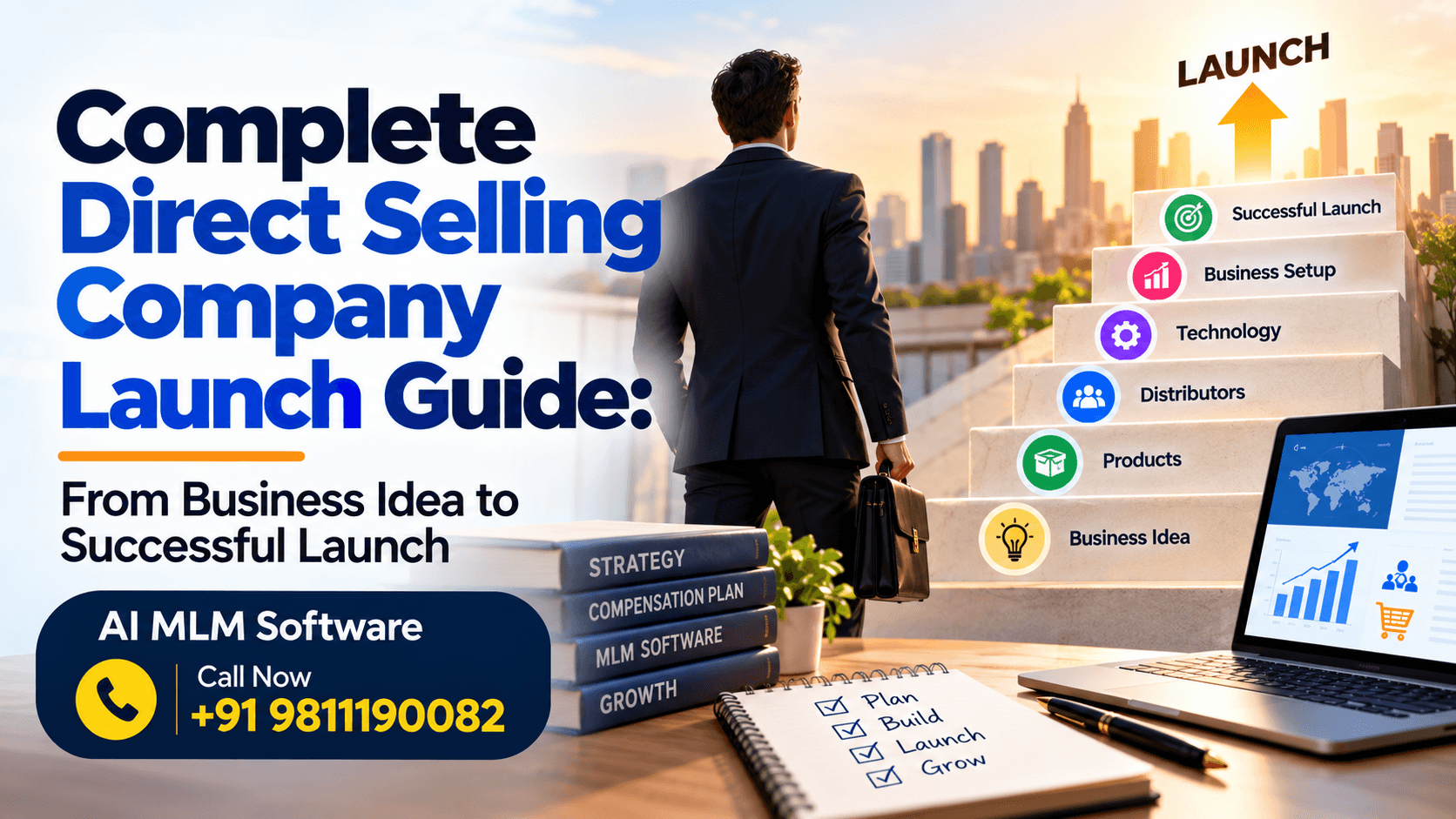
Complete Direct Selling Company Launch Guide: From Business Idea to Successful Launch
Starting a direct selling company involves much more than creating a compensation plan and recruiting distributors. A successful launch requires a clear product strategy, a workable business model, appropriate legal and compliance planning, distributor policies, technology, payment systems, eCommerce, training and a plan for acquiring and retaining customers.
This Complete Direct Selling Company Launch Guide explains the major steps involved in starting a direct selling company and building the technology and business systems needed to operate it.
Whether you are planning to start a direct selling company, launch an MLM business, build a network marketing company or expand an existing direct selling operation, the objective should be to create a business that can manage real product sales, customers and distributors efficiently as it grows.
How to Start a Direct Selling Company
A direct selling company connects products or services with customers through an independent distributor or sales network.
The business can be relatively simple in its early stages. As the distributor network expands, however, the company needs systems to manage registrations, customers, orders, commissions, inventory, payments, communication and reporting.
A successful launch therefore needs to bring together several areas of the business:
Business Model → Product → Compensation → Compliance → Distributors → Technology → Sales → Operations → Growth
Each part affects the others.
For example, the compensation plan affects the software, the product pricing affects the commission structure, and the customer sales model affects how distributors are rewarded.
That is why a direct selling company should be planned as a complete business rather than as an MLM software project alone.
1. Define Your Direct Selling Business Model
The first step is to decide what you are actually selling and how customers will purchase it.
A direct selling company can operate through physical products, subscription products, services or a combination of offerings.
Before developing the technology, clearly define:
What products or services will be sold?
Who is the target customer?
Who will sell the products?
How will distributors earn?
How will customers place orders?
Will customers also be able to purchase directly?
Will the company operate in one country or multiple markets?
The answers form the foundation for the rest of the business.
A common mistake is to select MLM software first and then attempt to fit the business model into whatever the software supports.
The better approach is to define the business requirements first and select or develop technology around them.
2. Choose the Right Products
Products are at the center of a sustainable direct selling business.
The compensation structure may attract distributors, but the company ultimately needs customers who want the products or services.
Product selection should therefore consider market demand, pricing, margins, repeat purchase potential, competition, distribution costs and customer value.
For businesses based on repeat purchases, it is also important to understand how often customers are likely to reorder and how that repeat business will affect distributor income.
A simple business flow might be:
Product → Customer → Purchase → Distributor Sale → Repeat Purchase
The stronger the connection between genuine customer demand and the product, the more meaningful the sales data becomes for the company.
3. Prepare Your Direct Selling Business Plan
Before launch, create a written Direct Selling Business Plan.
It should explain how the company will acquire customers, sell products, manage distributors and generate revenue.
The plan should cover the company's target market, product strategy, pricing, distribution model, marketing approach, expected operating costs and technology requirements.
It should also explain how the business intends to expand.
For example, a company may begin with one product category and later add more products, distributors, warehouses and countries.
Planning this expansion early can help prevent the technology and operational structure from becoming restrictive later.
4. Design the Direct Selling Compensation Plan
The compensation plan is one of the most important parts of an MLM or direct selling business.
Common structures include:
Unilevel
Binary
Matrix
Generation
Hybrid
Custom compensation plans
However, choosing a compensation structure simply because it is popular is not enough.
The plan should make sense alongside your product pricing, customer sales, distributor activities and company economics.
You need to define how commissions are calculated, when distributors qualify, what sales volume is considered, how ranks work and how different bonuses interact.
The compensation plan should also be reviewed for compliance with the laws and regulations applicable to the markets in which the company will operate.
Once the rules are finalized, they can be translated into the MLM commission software and tested against real business examples.
5. Plan Legal and Compliance Requirements
Legal and compliance planning should begin before the company starts recruiting distributors or selling products.
Requirements can vary depending on the country, products, sales model, advertising practices and business structure.
The company should review applicable requirements relating to:
Company registration
Consumer protection
Direct selling regulations
Product approvals where applicable
Taxation
Distributor agreements
Refund and cancellation policies
Advertising and product claims
Data protection
Payment processing
Customer communication
Software can help implement business rules, maintain records and create reports, but software itself does not make a direct selling business legally compliant.
The company's compensation plan, product claims, distributor agreements and operating practices should be reviewed by qualified legal and compliance professionals for the relevant market.
6. Create Distributor Policies and Agreements
Distributors are an important part of the direct selling operation, so their relationship with the company should be clearly documented.
The company should establish policies covering distributor registration, conduct, product sales, commissions, returns, customer handling, use of company branding, marketing claims and termination or suspension where applicable.
A well-defined distributor agreement also gives the software team clearer rules to implement.
For example, if a distributor becomes eligible for a particular rank only after meeting certain sales conditions, those conditions can be reflected in the MLM software.
7. Build a Distributor Onboarding Process
A new distributor should not simply receive a username and password.
The onboarding experience should help the distributor understand the products, business model, sales process, policies and available tools.
A digital onboarding process can include:
Registration → KYC/Verification → Agreement → Training → Product Information → Business Dashboard → Start Selling
The exact process will depend on the company's market and compliance requirements.
A good onboarding system can also help the company track whether distributors have completed required steps before becoming active.
8. Select the Right Direct Selling Software
Technology becomes increasingly important as soon as the company starts processing significant numbers of distributors, customers and transactions.
A complete Direct Selling Software platform can bring several business functions together:
Distributor Management → Genealogy → Compensation → Orders → Inventory → Payments → eWallet → CRM → Reporting
Instead of maintaining separate spreadsheets for distributors, commissions and orders, the company can use a centralized platform.
The software should be selected according to the actual business model rather than simply choosing a system with the longest feature list.
9. Build Your MLM Compensation Engine
Once the compensation plan has been finalized, the software needs to translate those rules into accurate calculations.
The commission engine may need to process sales volume, ranks, bonuses, matching income, incentives, qualifications, adjustments and payout rules.
This is one area where testing is particularly important.
The development team should take actual examples from the approved compensation plan and verify that the software produces the expected result.
For example:
Distributor A → Customer Sale → Qualified Volume → Rank Condition → Commission Rule → Commission → Wallet
Every step should be traceable.
10. Set Up MLM Genealogy and Distributor Management
The genealogy system represents the relationship between distributors.
Depending on the compensation plan, the platform may need to manage sponsor relationships, placement, levels, teams, ranks and downline activity.
The distributor dashboard should provide relevant information without making the system difficult to understand.
A distributor may need to see:
My Business → My Team → Customers → Orders → Commissions → eWallet → Reports
Management, meanwhile, may require a much broader view across the entire organization.
11. Connect eCommerce With Direct Selling
A modern direct selling company should not treat its eCommerce platform and MLM system as completely separate systems.
The customer journey can be connected as:
Product Catalogue → Customer → Order → Payment → Inventory → Distributor Attribution → Commission
This allows customer orders to become part of the company's wider sales and distributor reporting.
For companies selling directly to customers as well as through distributors, this type of integration can be particularly important.
12. Integrate Payments and eWallets
Payments are another critical part of the direct selling technology stack.
The business may need to process customer orders as well as distributor commissions and withdrawals.
The overall flow can look like:
Customer Payment → Order → Sales Record → Commission Calculation → Distributor eWallet → Payout
The company should select payment gateways based on its markets, products and applicable requirements.
The eWallet should also maintain a clear transaction history so distributors and management can understand how balances were generated.
13. Connect Inventory with the Sales Network
If your company sells physical products, inventory management needs to be connected with the direct selling platform.
The company may have:
Supplier → Central Warehouse → Regional Warehouse → Distributor → Customer
As products move through the network, the inventory system should record the relevant transactions.
Integration between MLM software, eCommerce and inventory can provide better visibility into product availability, orders and sales.
This becomes increasingly important when the business introduces more products or expands into multiple warehouses.
14. Add CRM for Leads and Customers
Direct selling is ultimately about relationships with customers and prospects.
An integrated CRM for MLM can help the company and distributors manage leads, customer records, follow-ups and sales opportunities.
A practical workflow can look like:
Lead → Follow-Up → Product Discussion → Order → Customer → Repeat Purchase
The CRM can also provide management with information about customer activity and distributor follow-up.
When CRM and MLM software are connected, customer activity can be viewed alongside distributor and sales information.
15. Provide a Distributor Mobile App
Distributors are often working away from an office, making mobile access particularly useful.
A Direct Selling Mobile App can provide access to business information such as genealogy, orders, products, commissions, eWallets, customers and reports.
The app can also support notifications and communication.
For a growing company, the mobile experience should be considered part of the distributor platform rather than an optional addition after the main software has been completed.
16. Build Reporting and Business Intelligence
Once the business begins generating transactions, management needs reliable information to understand what is happening.
Important areas may include distributor activity, sales, customer purchases, commissions, product performance, orders, inventory and payouts.
Instead of manually preparing reports, a centralized dashboard can provide management with a current view of the business.
For example:
Sales → Distributor Performance → Customer Activity → Product Performance → Commission Cost → Business Growth
This helps management connect different parts of the business rather than looking at each report independently.
17. Plan Training and Distributor Support
Software alone does not create a successful direct selling organization.
Distributors need to know how to use the platform and how to sell the products.
Training can cover the product catalogue, customer acquisition, ordering, distributor dashboards, commissions, mobile applications and company policies.
The company can provide training through videos, webinars, documents, live sessions or an integrated training platform.
The easier the system is to understand, the less support the company may need to provide for routine distributor questions.
18. Prepare Your Launch Marketing Strategy
Before the public launch, prepare the company's marketing materials and communication channels.
This can include the company website, product pages, distributor recruitment materials, social media content, email communication, product education and customer support processes.
The marketing message should focus on the actual products and customer value.
Distributor recruitment should also be based on accurate information about the business opportunity, earnings and requirements.
The company should establish clear approval processes for distributor-generated marketing content so that product and income claims remain consistent with company policies and applicable regulations.
19. Test the Complete Direct Selling System
Before launching, test the complete customer and distributor journey rather than testing individual modules only.
A useful test scenario might be:
Distributor Registration → Verification → Product Purchase → Payment → Order → Inventory Update → Commission Calculation → eWallet → Report
Test different situations as well, including cancellations, refunds, failed payments, commission adjustments, rank changes and returns.
This is particularly important because a problem in one module can affect several other areas.
20. Start With a Controlled Launch
A controlled launch allows the company to identify operational issues before opening the platform to a large distributor network.
The company can begin with a limited group of distributors, process real transactions and monitor customer and distributor feedback.
During this stage, pay close attention to:
Registration
KYC or verification
Product ordering
Payments
Commission calculations
Wallet transactions
Customer support
Reporting
Mobile application performance
Once the major processes are working as expected, the company can gradually expand the network.
Direct Selling Company Launch Checklist
Before launch, make sure the major parts of the business have been addressed:
Area
Launch Requirement
Business Model
Clear target market and revenue model
Products
Products, pricing and customer value defined
Compensation
Approved compensation structure
Compliance
Applicable legal and regulatory review
Distributor Policies
Agreements and operating policies
Onboarding
Registration and distributor onboarding
MLM Software
Core platform configured or developed
eCommerce
Product ordering and customer sales
Payments
Customer and distributor payment processes
Inventory
Stock and order management
CRM
Lead and customer management
Mobile App
Distributor access where required
Reporting
Management and distributor dashboards
Training
Product and software training
Marketing
Website, content and launch communication
Testing
End-to-end business testing
Support
Post-launch technical and distributor support
Common Mistakes When Starting a Direct Selling Company
One common mistake is starting distributor recruitment before the product, compensation plan, policies and operational systems are ready.
Another is choosing software based entirely on price or the number of features displayed in a sales presentation.
A third mistake is treating technology as an afterthought.
If the compensation plan, eCommerce, inventory, CRM and payment systems are designed independently, integrating them later can become more complicated.
It is also important not to rely entirely on recruitment as a growth strategy. A product-based direct selling business needs genuine customers, repeat sales and a sustainable operating model.
When Should You Build Custom MLM Software?
Custom MLM software becomes particularly useful when the company's requirements do not fit comfortably into a standard platform.
This may happen when the business needs a specific compensation plan, multiple countries, special product structures, custom customer journeys, ERP integration, unique payment workflows or advanced reporting.
A custom platform can be designed around the company's actual operating process:
Business Requirements → Compensation Plan → Technology Architecture → Development → Integration → Testing → Launch
This can provide greater flexibility as the company grows.
How AI MLM Software Can Help Launch Your Direct Selling Company
AI MLM Software provides technology and consulting services for companies planning to launch or expand direct selling businesses.
Its services include MLM software development, compensation plan design, direct selling consultancy, MLM eCommerce, mobile applications, automation, business intelligence and integrations.
The advantage of combining business consultancy with software development is that the technology can be planned around the actual direct selling model.
For example, the company can connect:
Distributor Management → Compensation → CRM → eCommerce → Inventory → Payments → eWallet → Reporting
This creates a connected platform instead of several independent systems.
AI MLM Software is developed by Vista Neotech Pvt. Ltd. and states that it has 25+ years of experience, 3,000+ projects and experience across 50+ business verticals.
How Much Does It Cost to Start a Direct Selling Company?
There is no single cost for launching a direct selling company.
The investment depends on the product, business structure, market, team, technology, compensation plan, eCommerce requirements, inventory, marketing and operational requirements.
Technology costs can vary significantly depending on whether the company uses ready-made MLM software or develops a custom platform.
A basic platform may require only distributor management and compensation, while an international direct selling company may need:
MLM Software + CRM + eCommerce + Mobile App + ERP + Inventory + Payment Integration + Analytics + Automation
For this reason, it is better to define the complete business requirements before requesting a software development quotation.
Can AI Be Used in a New Direct Selling Business?
Yes, but it should be applied to specific business requirements.
AI can potentially support areas such as lead management, customer insights, distributor engagement, business reporting, sales analysis and workflow automation.
For example, an AI-enabled system could help identify distributors who need follow-up, analyze sales patterns or help management understand customer activity.
The goal should be practical: use technology where it can reduce manual work, improve visibility or help the business make better use of its data.
Final Thoughts: Build the Business Before You Build the Network
Launching a direct selling company successfully requires more than recruiting distributors.
The company needs a product customers want, a clearly defined business model, an appropriate compensation structure, sound operational policies, suitable technology and a system for supporting distributors and customers.
The technology should connect the business from end to end:
Product → Customer → Distributor → Order → Payment → Inventory → Commission → eWallet → Reporting
When these processes are planned together, the company has a stronger foundation for managing growth.
Planning to Launch a Direct Selling Company?
Talk to AI MLM Software about your direct selling business model, compensation plan, MLM software, eCommerce, mobile app and automation requirements.
Call Now: +91 9811190082