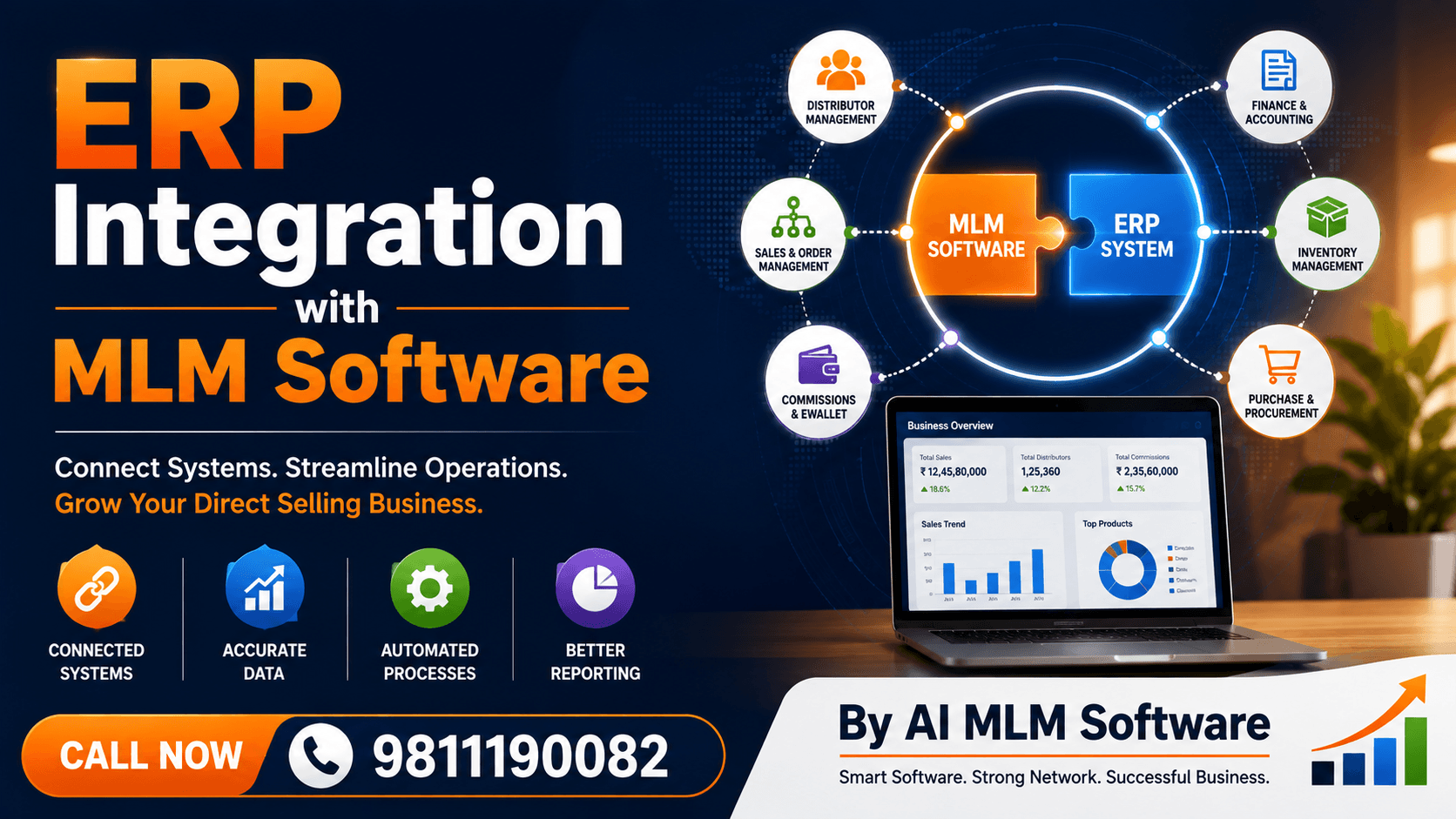
A growing direct selling company rarely operates through one system. Sales may be managed through one platform, inventory through another, accounting through a separate application, while distributor information, commissions and genealogy remain inside the MLM software.
As the business grows, this separation can create unnecessary work.
Employees may have to enter the same information into multiple systems. Management may wait for reports to be consolidated. Finance teams may struggle to match orders with payments and commissions. Inventory teams may not have immediate visibility into product movement.
This is where ERP Integration with MLM Software becomes valuable.
By connecting ERP and MLM systems, direct selling companies can bring important business operations together while allowing each system to perform the functions it is designed for.
AI MLM Software provides customized MLM software development and integration capabilities to help direct selling companies connect their distributor network with wider business operations.
What Is ERP Integration with MLM Software?
ERP Integration with MLM Software means connecting the MLM platform with an Enterprise Resource Planning system so that relevant business information can move between the two systems automatically.
An MLM system generally manages areas such as:
Distributor registration
Sponsor and genealogy management
Sales volume
Commission calculation
Rank management
eWallet
Distributor income
Team performance
An ERP system generally manages:
Finance
Accounting
Inventory
Procurement
Sales
Purchasing
Operations
Business reporting
When these systems are integrated, information can flow between them without requiring employees to repeatedly enter the same data.
Why Direct Selling Companies Need ERP and MLM Integration
A direct selling company may process thousands of transactions involving distributors, customers, products, payments and commissions.
Without proper integration, businesses can face:
Duplicate data entry
Delayed reports
Manual reconciliation
Inventory discrepancies
Payment matching problems
Commission-related queries
Difficulty tracking business performance
ERP integration helps create a more connected business environment.
Instead of managing isolated information, management can get a clearer view of how sales, inventory, finance and distributor activity are connected.
How ERP Integration with MLM Software Works
The exact integration depends on the company's systems and business requirements.
A typical process may look like:
Distributor / Customer → MLM Software → Order → ERP → Inventory & Accounts → Payment → Commission → MLM Wallet
For example, when a distributor places an order through the MLM platform, the transaction can be transferred to the ERP system.
The ERP can then update relevant inventory and accounting records, while the MLM system continues to handle distributor-related calculations.
This reduces repetitive work and keeps information consistent between systems.
Key Areas of ERP Integration with MLM Software
1. Sales Integration
Sales information is one of the most important areas to connect.
Integration can help transfer:
Customer orders
Distributor orders
Product sales
Order values
Tax information
Discounts
Order status
Management can then review sales information alongside other business operations.
2. Inventory Integration
Inventory becomes particularly important for product-based direct selling companies.
ERP and MLM integration can connect:
Product catalogue
Stock availability
Warehouse inventory
Stock movement
Product returns
Order fulfilment
When a product is sold through the MLM system, the relevant inventory information can be reflected in the ERP system.
This helps reduce differences between actual and recorded stock.
3. Finance & Accounting Integration
Financial data should not remain isolated from sales and order information.
Integration can connect:
Sales transactions
Payments
Refunds
Discounts
Taxes
Expenses
Distributor payouts
This can make financial reconciliation easier and provide finance teams with better transaction visibility.
4. Commission Integration
Commission management is a central function of MLM software.
The MLM system can continue calculating commissions according to the company's compensation plan while relevant financial information can be made available to the ERP system.
This can help connect:
Sales → Commission Calculation → Payable Amount → Finance → Distributor Payment
Such integration reduces the need for manual reconciliation between business and finance teams.
5. Purchase & Procurement Integration
When inventory reaches a certain level, procurement teams need accurate information to plan purchases.
ERP integration can provide information about:
Current stock
Product movement
Purchase requirements
Supplier information
Pending orders
This gives businesses better control over procurement planning.
6. Customer Data Integration
Customer and distributor information can often exist across multiple business systems.
Integration can help maintain relevant information such as:
Customer details
Distributor ID
Order history
Purchase records
Contact information
Account status
This reduces duplicate data entry and makes customer information easier to manage.
7. Reporting & Business Dashboards
One of the biggest advantages of ERP and MLM integration is improved reporting.
Management can bring together information relating to:
Sales
Distributor growth
Product performance
Inventory
Revenue
Commission
Payments
Customer activity
This creates a more complete view of the business.
Benefits of ERP Integration with MLM Software
Reduced Manual Data Entry
Employees do not have to repeatedly enter the same information into different systems.
Better Data Accuracy
Connected systems reduce the possibility of discrepancies caused by manual data entry.
Faster Business Reporting
Management can access consolidated information more quickly.
Better Inventory Control
Sales and inventory information can be connected for improved stock visibility.
Easier Financial Reconciliation
Finance teams can match sales, payments and commission information more efficiently.
Improved Distributor Experience
Accurate order, wallet and commission information helps reduce unnecessary distributor queries.
Greater Operational Control
Management gets a broader view of business activity across departments.
ERP Integration Does Not Mean Replacing Your MLM Software
This is an important consideration for established direct selling companies.
A company may already have a well-developed MLM platform containing:
Distributor database
Genealogy
Compensation plan
Commission engine
eWallet
Distributor portal
Mobile application
Replacing the entire system may not always be necessary.
Instead, MLM ERP Integration can allow the company to retain its existing MLM infrastructure while connecting it with ERP software.
The integration strategy should be based on the existing technology, business processes and future requirements.
How AI MLM Software Makes ERP Integration More Beneficial
At AI MLM Software, we understand that every direct selling company operates differently.
Some companies may need basic inventory and accounting integration. Others may require connections between MLM, ERP, CRM, eCommerce, payment gateways and mobile applications.
Our approach is to understand the complete business workflow before designing the integration.
AI MLM Software can help with:
Custom MLM Software Development
Developing MLM platforms around specific compensation plans and business requirements.
ERP Integration
Connecting MLM software with ERP systems and transferring relevant business information.
API Integration
Creating and connecting APIs between MLM, ERP and third-party applications.
eCommerce Integration
Connecting online orders with distributor, inventory and business systems.
Payment Gateway Integration
Connecting payment transactions with orders and financial records.
CRM Integration
Linking customer and distributor interactions with business operations.
Business Dashboards
Combining important information into management reports and dashboards.
Mobile App Integration
Connecting distributor mobile applications with the central MLM and ERP environment.
A Typical ERP and MLM Integration Architecture
A direct selling business may have several systems working together:
MLM Software
Distributor Management → Genealogy → Commission → eWallet
ERP System
Finance → Inventory → Procurement → Accounting
CRM
Leads → Customers → Follow-Ups → Customer History
eCommerce
Products → Orders → Payments → Delivery
Integration Layer
APIs → Data Exchange → Authentication → Synchronisation
This connected structure allows information to move between systems while each application continues performing its core functions.
What Should You Check Before ERP Integration?
Before beginning an ERP Integration with MLM Software project, businesses should evaluate:
Existing Software
Understand the MLM and ERP platforms currently being used.
Database Structure
Review how customer, distributor, product and transaction information is stored.
APIs
Check whether the systems provide APIs or other integration methods.
Business Processes
Identify exactly which information needs to move between systems.
Security
Define authentication, access control and data protection requirements.
Synchronisation
Decide whether information needs to be transferred in real time, periodically or on specific events.
Reporting Requirements
Identify which reports require information from both ERP and MLM systems.
Proper planning can prevent expensive changes later in the project.
Common ERP Integration Challenges
ERP and MLM integration can become complicated when businesses do not properly define their requirements.
Common challenges include:
Different database structures
Inconsistent product codes
Duplicate customer records
Different transaction formats
Legacy MLM software
Limited API availability
Complex compensation plans
Data synchronisation issues
An experienced MLM Software Development Company can help identify these issues before implementation.
Why Custom Integration Can Be Better Than a Generic Connector
A standard connector may work for simple requirements, but established direct selling businesses often have unique processes.
For example, one company may calculate commissions after payment confirmation, while another may calculate them based on specific sales volume conditions.
Similarly, product returns, refunds, distributor orders and tax handling may vary from company to company.
Custom integration allows these business rules to be considered during implementation.
ERP Integration for Growing Direct Selling Companies
As a direct selling company grows, the number of transactions and business functions also increases.
A connected technology environment can support:
More distributors
More products
More orders
Multiple warehouses
Multiple locations
Multiple payment methods
International operations
More detailed reporting
The objective is to create an infrastructure that can support business growth without making daily operations unnecessarily complicated.
Why Choose AI MLM Software?
AI MLM Software focuses on developing technology specifically for direct selling and MLM businesses.
Our capabilities include:
MLM Software Development
ERP Integration
Custom Compensation Plans
Commission Automation
eWallet Development
Distributor Mobile Apps
API Integration
CRM Integration
eCommerce Integration
Business Dashboards
Multi-Currency MLM Software
Cloud-Based MLM Software
The focus is not simply on connecting two systems. The objective is to ensure that the integration supports the way the business actually operates.
Final Thoughts
ERP Integration with MLM Software can help direct selling companies bring sales, inventory, finance, orders, distributor activity and commissions into a more connected business environment.
The biggest benefit is not simply having two systems communicate with each other. It is reducing unnecessary manual work and giving management better visibility into how different parts of the business work together.
For companies already using MLM software, integration can also provide a practical way to modernise operations without necessarily replacing the entire existing platform.
With AI MLM Software, businesses can plan, develop and integrate custom MLM and ERP solutions according to their compensation plan, operational workflow and future growth requirements.
The right integration should make the business simpler to manage, easier to monitor and better prepared for growth.
Also Read: Distributor Mobile App Features Every Direct Selling Company Should Have