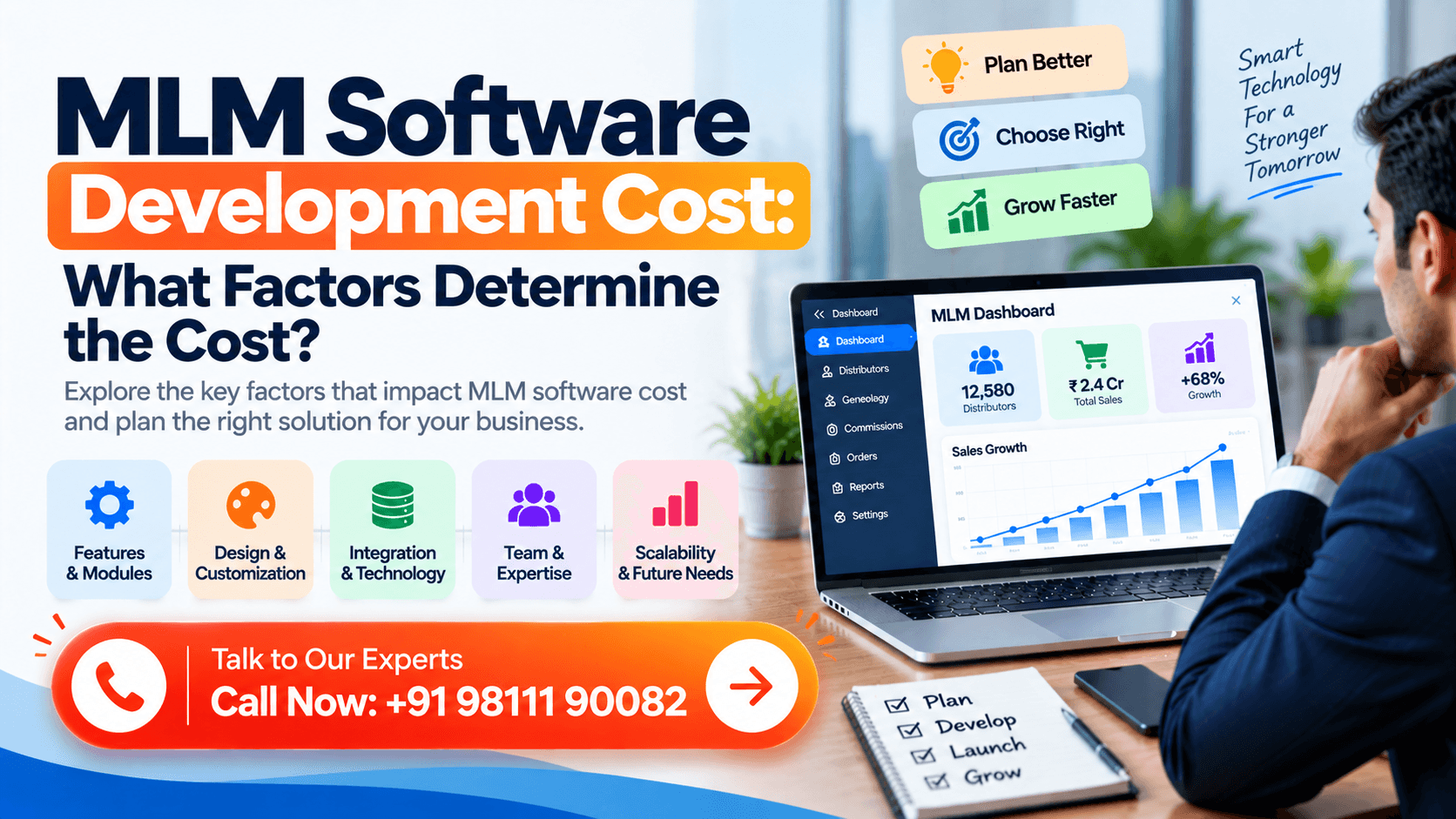
One of the first questions asked by an MLM or direct selling company is simple: What is the MLM software development cost?
The answer cannot be reduced to one standard price.
MLM software is closely connected to the way a direct selling company operates. The compensation plan, distributor structure, products, payment process, mobile requirements, integrations, reporting needs and future expansion plans can all change the scope of development.
A basic distributor management system and a fully customized international direct selling platform are two very different software projects.
So instead of looking for a fixed figure, businesses should first understand what determines the cost of MLM software development and which components are actually necessary for their business.
This guide explains those factors without quoting artificial or misleading price ranges.
Why MLM Software Development Cost Varies From Business to Business
There is no universal MLM software package that fits every direct selling company.
One business may need only distributor registration, genealogy, commissions and basic reporting. Another may require multiple compensation plans, e-commerce, inventory, payment gateways, mobile applications, CRM, ERP, multi-currency support and advanced analytics.
The development effort changes accordingly.
A useful way to think about the project is:
Business Model → Compensation Plan → Required Modules → Integrations → Security → User Experience → Scalability → Support
Each decision adds to or reduces the overall development scope.
What Is Included in MLM Software Development?
MLM software development involves creating or customizing a technology platform to manage the operational requirements of a multi-level marketing or direct selling business.
Depending on the business model, the platform may manage distributors, genealogy, commissions, orders, products, payments, e-wallets, customers, reporting and communication.
The software may also connect with external systems such as payment gateways, CRM platforms, ERP systems, e-commerce websites and mobile applications.
This is why comparing MLM software only by the number of features can be misleading. Two platforms may have similar feature names while having very different levels of customization and technical complexity.
The Major Factors That Determine MLM Software Development Cost
1. Your MLM Business Model
The first factor is the business model itself.
A direct selling company needs to decide how distributors will sell products, build teams and qualify for incentives. The software must then represent those rules accurately.
For example, a company may operate with a:
Unilevel plan
Binary plan
Matrix plan
Generation plan
Hybrid plan
Custom compensation structure
The more specific and complex the business rules are, the more attention is required during planning, development and testing.
AI MLM Software's documented approach supports compensation structures including Unilevel, Binary, Matrix and Hybrid models, with the compensation engine designed around the underlying business rules.
2. Compensation Plan Complexity
The compensation plan deserves separate attention because it is often at the heart of an MLM platform.
A compensation plan may involve multiple qualification conditions, levels, bonuses, ranks, matching incentives, commissions and other calculations.
The software needs to interpret these rules correctly for every eligible transaction.
For example:
Product Sale → Qualification Check → Commission Calculation → Wallet → Payout → Reporting
If the rules change frequently or contain many conditions, development and testing become more involved.
This is why businesses should finalize their MLM compensation plan before beginning serious software development.
3. Distributor and Genealogy Management
Every MLM business needs to manage relationships between distributors.
The system may need to record sponsors, placements, downline structures, ranks and team relationships while allowing distributors to view their genealogy.
As the network grows, the technology must continue to retrieve and update this hierarchical information efficiently.
A simple distributor database and a large network genealogy system are therefore very different technical requirements.
AI MLM Software's architecture specifically addresses user management and genealogy tracking as core parts of an MLM platform.
4. Features and Modules You Need
The number and complexity of modules also affect development effort.
A business may require only core MLM functions initially, while another may want a complete direct selling platform.
Common modules can include:
Distributor Management | Genealogy | Compensation | E-Wallet | Orders | Products | Inventory | Customers | KYC | Reports | Analytics | CRM | Mobile App
The important question is not, “How many features can we get?”
It is:
Which functions does the business actually need to operate efficiently?
Starting with essential modules can keep the initial project focused while allowing additional functionality to be introduced as the company grows.
5. Customization Requirements
Ready-made MLM software can work for businesses with relatively standard requirements.
However, companies often have their own distributor workflows, compensation rules, approval processes, product structures and reporting requirements.
When software must be modified around those requirements, the level of customization becomes an important factor in the custom MLM software cost.
Customization may involve the user interface, business rules, database structure, dashboards, workflows, reports or integrations.
AI MLM Software's source material emphasizes customization around unique business requirements rather than forcing every company into the same operating model.
6. Website and E-Commerce Requirements
Some direct selling companies need more than a distributor back office.
They may require a customer-facing website, online product catalogue, distributor shopping portal or integrated e-commerce platform.
In that situation, the software may need to connect:
Customer → Product → Order → Payment → Inventory → Commission
This adds additional development and integration requirements.
If your business intends to sell products online, e-commerce should therefore be considered during the initial software planning rather than treated as a separate requirement later.
7. Payment Gateway and E-Wallet Integration
Financial transactions are another major component of MLM software.
Depending on the business, the platform may need to support customer payments, distributor purchases, refunds, wallet transactions, commissions and payouts.
Payment integration can also vary by country and payment provider.
The complexity increases when a business operates across different markets, currencies or payment methods.
A properly designed financial workflow should make transactions traceable from the original order through commission calculation and payout.
8. MLM Mobile App Development
Many distributors manage their businesses primarily through smartphones.
If you require an MLM mobile app, development scope increases because the mobile experience needs to be designed, developed, tested and connected with the main platform.
The application may provide access to:
Distributor dashboard
Genealogy
Commissions
E-wallet
Orders
Product catalogue
Reports
Notifications
Team performance
AI MLM Software's existing material describes mobile-responsive dashboards and mobile access to business information as part of its MLM offering.
A dedicated native or cross-platform mobile application can be planned according to the company's requirements.
9. Third-Party Integrations
Modern direct selling businesses rarely operate in complete isolation.
Your MLM software may need to communicate with other applications.
For example:
MLM Software → CRM → WhatsApp
MLM Software → E-Commerce → Payment Gateway
MLM Software → ERP → Inventory & Accounting
MLM Software → Mobile App → Distributor
Every integration requires planning around APIs, authentication, data exchange, error handling and testing.
Therefore, the number and complexity of integrations can have a direct effect on development effort.
10. Reporting and Business Analytics
Reporting requirements also influence the overall scope.
A basic system may require standard distributor and commission reports.
A larger company may want management dashboards showing sales, distributor activity, regional performance, product movement, recruitment, commissions and other business indicators.
AI MLM Software's documented platform approach includes reporting and analytics alongside distributor, genealogy, compensation and financial functions.
The more specific the reporting requirements, the more planning may be needed for data structures, dashboards and business intelligence.
11. Security and Access Control
MLM software handles sensitive business information.
This can include distributor profiles, financial transactions, customer information, commissions and payment-related data.
Security requirements may include secure authentication, role-based access, password protection, data encryption and two-factor authentication.
AI MLM Software's existing material specifically describes password protection, data encryption and two-factor authentication as security measures within its MLM software offering.
The security architecture should be considered during development rather than added as an afterthought.
12. Multi-Currency and International Operations
If your business plans to operate internationally, additional requirements may need to be considered from the beginning.
These can include multiple currencies, languages, payment methods, regional configurations and country-specific operational requirements.
International MLM software therefore requires more planning than a platform designed for a single market.
AI MLM Software's architecture documentation identifies multi-currency wallets and support for international operations as part of its approach to MLM platforms.
13. Scalability and Expected Distributor Volume
The size of your business today should not be the only consideration.
Think about where you expect the network to be in the future.
A platform should be able to handle increasing numbers of:
Distributors + Customers + Orders + Transactions + Products + Reports
This requires appropriate architecture, database design, server infrastructure and performance planning.
Building for scalability at the beginning can be more practical than rebuilding the entire system after the network has grown.
14. User Experience and Dashboard Design
Software can have all the required functions and still be difficult to use.
Distributors should be able to understand their business without navigating through complicated screens.
An administrator, meanwhile, needs access to detailed controls and reports.
The user interface therefore has to balance simplicity with functionality.
For example, a distributor may need to see:
Sales → Commission → Team → Rank → Wallet
while management may need:
Sales → Network → Products → Finance → Performance → Reports
Designing these experiences properly takes planning and testing.
15. Data Migration From Existing MLM Software
If you are replacing an existing platform, migration becomes another important factor.
The business may need to move distributor profiles, genealogy, orders, commissions, wallets, customers and historical transactions into the new system.
The challenge is not simply transferring database records.
The new system must interpret the old data correctly and preserve important relationships and financial history.
Migration therefore requires data mapping, cleansing, backup, testing and validation.
For an established MLM company, this can become a significant part of the software project.
16. Testing and Quality Assurance
MLM software requires more than normal interface testing.
The underlying business rules must also be tested.
A typical test flow could be:
Distributor Registration → Placement → Product Order → Payment → Commission → Wallet → Payout → Report
Different distributor levels, qualification conditions and transaction scenarios may need to be tested separately.
This is especially important for compensation calculations because a small logic error can affect multiple accounts.
Time spent on proper testing is therefore part of the investment in reliable MLM software.
17. Hosting, Infrastructure and Ongoing Support
Software development does not necessarily end when the application is launched.
Depending on the architecture, you may also need cloud infrastructure, monitoring, backups, security updates, performance management and technical support.
The support requirement will depend on the size and operating model of your business.
A company processing transaction continuously across multiple markets will naturally have different infrastructure and support requirements from a small operation serving a limited network.
Why Choosing the Right MLM Software Company Matters
When comparing MLM software development companies, do not evaluate them only by development cost.
Look at whether the company understands both sides of the project:
MLM Business Requirements + Software Engineering
A developer may be technically capable but unfamiliar with compensation plans, genealogy structures, distributor workflows and MLM financial processes.
Likewise, an MLM consultant without strong development capability may struggle to build the required technology.
The right partner should understand how the business rules translate into software.
Why Choose AI MLM Software for Direct Selling Software?
AI MLM Software approaches direct selling technology around the operational requirements of the MLM business rather than treating it as a standard website project.
Its documented capabilities include distributor management, genealogy, compensation processing, financial transactions, reporting and analytics, with architecture designed to support different compensation structures and future expansion.
For a direct selling company, this can provide several practical advantages.
Business and Technology Understanding
The development process can begin with understanding the compensation plan, distributor structure and business workflow before translating those requirements into software.
Custom Compensation Plan Support
Businesses can plan software around their required compensation structure instead of changing the business model simply to match an existing platform. AI MLM Software's materials specifically reference Unilevel, Binary, Matrix and Hybrid structures.
Connected MLM Operations
Distributor management, genealogy, commissions, financial transactions, reporting and analytics can be planned as connected parts of the same platform.
Security-Focused Development
The platform materials describe security measures including encryption, password protection and two-factor authentication for protecting business information.
Room for Business Growth
The documented architecture uses modular components, allowing businesses to add capabilities without necessarily replacing the complete platform as requirements change.
Direct Selling Business Support
AI MLM Software also positions its offering around broader MLM services and consultancy rather than software development alone, covering areas such as marketing strategy, customer support, payment processing, training and website development.
This combination can be particularly useful for businesses that are building a direct selling operation from the ground up and need both business understanding and technology support.
How to Control MLM Software Development Cost Without Compromising the Project
The objective should not be to find the cheapest software.
Instead, focus on getting the right scope.
Start by defining the compensation plan and essential business processes. Separate must-have functions from features that can be introduced later.
For example, the first version may focus on:
Distributor Management → Genealogy → Compensation → Orders → Wallet → Reports
Additional requirements such as advanced analytics, CRM integrations, mobile applications or international functionality can then be planned according to the business roadmap.
This approach keeps development focused while leaving room for expansion.
What Should You Ask an MLM Software Development Company?
Before selecting a development partner, ask practical questions.
Can the company understand and implement your compensation plan?
Can it handle genealogy and commission calculations?
Can the software integrate with your payment gateway?
Can the platform support your expected distributor growth?
Can existing data be migrated if you already have MLM software?
What security measures are included?
Can the system support mobile users?
What happens when you need a new feature after launch?
These questions reveal much more about the actual value of an MLM software solution than the initial quotation alone.
A Better Way to Evaluate MLM Software Cost
Instead of asking:
“How much does MLM software cost?”
ask:
“What does my business need the software to do?”
Then break the requirement into five areas:
Business Model → Core Features → Integrations → Scale → Support
Once these are clear, a software development company can prepare a much more meaningful scope and commercial proposal.
This also prevents businesses from paying for unnecessary features or discovering major requirements after development has already started.
Final Thoughts
There is no meaningful universal answer to MLM Software Development Cost without first understanding the business behind the software.
The compensation plan, distributor structure, required modules, payment systems, integrations, mobile requirements, security, reporting, scalability and support all contribute to the overall scope.
The best approach is to start with the business requirements and then design the technology around them.
For a direct selling company, the right software should do more than calculate commissions. It should help connect distributors, products, orders, payments, financial transactions, reporting and business management in one organized system.
AI MLM Software combines MLM software development with direct selling technology and consultancy, making it a suitable option for companies that want to build a platform around their own compensation plan and operating requirements. Its documented approach focuses on scalable MLM architecture, compensation processing, genealogy, financial transactions and analytics.
Planning Your MLM Software Project?
Do not start with a price. Start with your requirements.
Share your compensation plan, distributor structure and business requirements with AI MLM Software, and get a technology plan designed around the way your direct selling business needs to operate.
Talk to AI MLM Software Experts
Call: +91 98111 90082