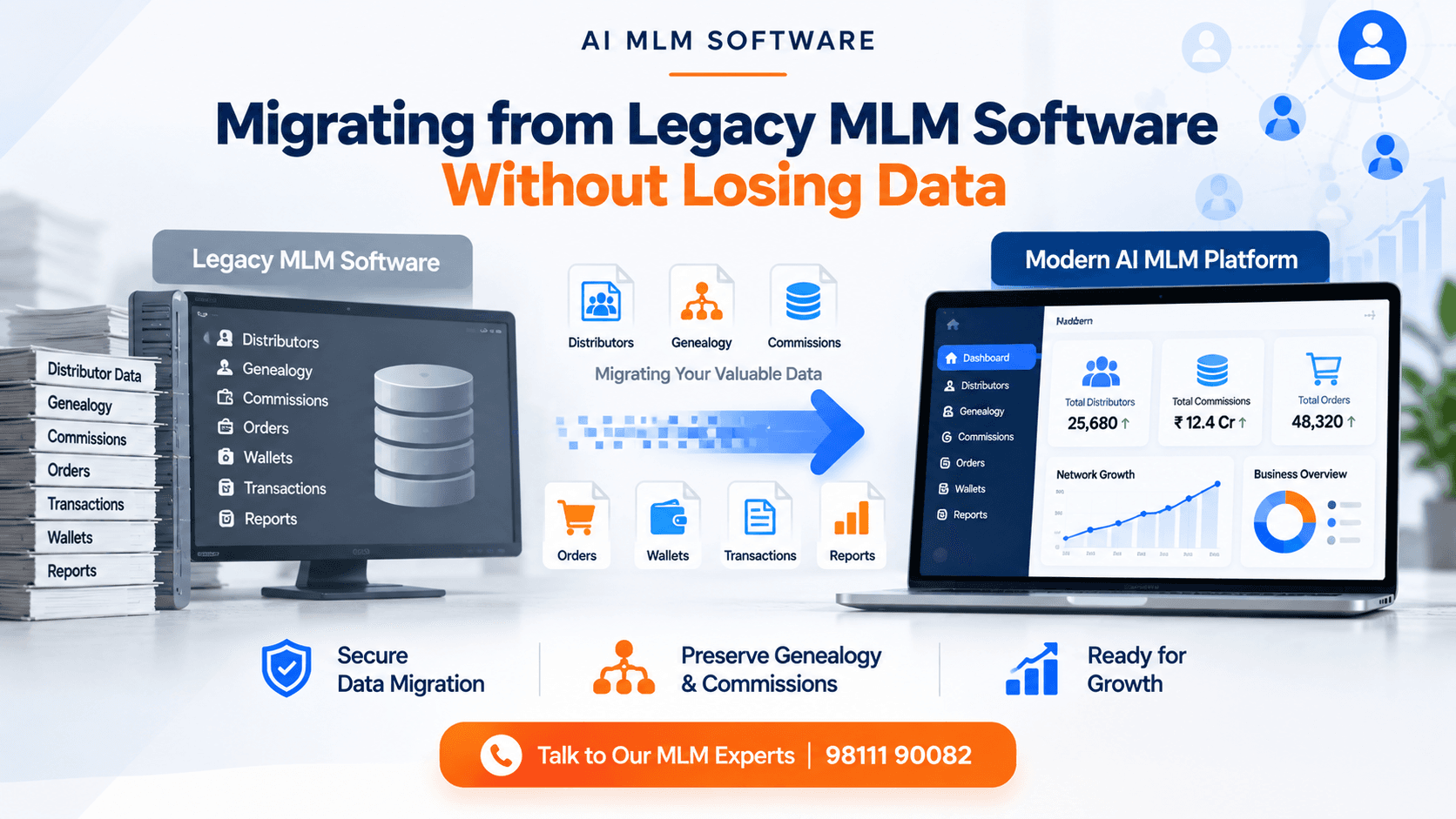
Migrating from Legacy MLM Software Without Losing Data
Your MLM business may have grown significantly since the software was first implemented.
What once handled a few hundred distributors may now be expected to manage thousands of distributors, complex genealogy structures, multiple compensation rules, product orders, wallets, commissions, payments, reports and customer information.
At some point, the problem may no longer be the business.
It may be the software running the business.
Older MLM systems can become difficult to maintain, slow to integrate with newer platforms and restrictive when the company wants to introduce new compensation plans, mobile applications, eCommerce, analytics or automation.
But replacing the software creates another major concern:
What happens to all the existing business data?
Distributor records, sponsor relationships, genealogy, orders, commissions, wallet balances and transaction history cannot simply be left behind.
A properly planned MLM software migration allows a direct selling company to move to a newer system while preserving the information required to continue its operations.
AI MLM Software helps direct selling companies develop and implement customized MLM platforms covering distributor management, genealogy, commissions, payouts, reporting, automation, eCommerce, mobile applications and integrations.
What Is Legacy MLM Software Migration?
Legacy MLM software migration is the process of moving data, business rules and relevant functionality from an existing MLM system to a new MLM software platform.
The migration can involve much more than transferring a database.
A typical MLM system may contain:
Distributor profiles
Sponsor relationships
Genealogy structures
Customer records
Product information
Orders
Sales volume
Commission history
Wallet balances
Payout records
Rank information
KYC information
Payment records
Reports
User login information
The new platform must understand this information correctly.
For example, transferring a distributor's name is relatively straightforward.
Transferring the distributor's complete genealogy position, sponsor relationship, sales history, commission records and wallet balance requires considerably more planning.
That is why MLM migration should be treated as a business project, not simply a database-copying exercise.
Why Do MLM Companies Replace Legacy Software?
There are several reasons a direct selling company may decide to move away from its existing MLM platform.
The Existing System Is Difficult to Maintain
Older software may depend on outdated technology, making modifications and technical support increasingly difficult.
The Software Cannot Support Business Growth
A system designed around a smaller distributor network may struggle when transaction volumes and network size increase.
Modern MLM platforms need to handle distributor networks, transactions, genealogy and commission calculations at scale. AI MLM Software's current architecture approach uses modular components for areas such as user management, genealogy, commission calculations, financial transactions and reporting.
New Compensation Plans Are Required
A company may want to introduce Binary, Matrix, Unilevel, Hybrid or customized compensation structures that the existing platform cannot support.
Integrations Are Limited
Modern direct selling businesses often need connections with:
MLM Software → ERP → CRM → eCommerce → Payment Gateway → Mobile App → Reporting
AI MLM Software's current integration services cover ERP, CRM, eCommerce, payment gateways, APIs and mobile applications.
Reporting Is Inadequate
Management may need real-time visibility into distributor growth, sales, inventory, commissions, payouts and regional performance.
Distributor Experience Has Become Outdated
Distributors increasingly expect mobile access to their genealogy, orders, commissions, wallet and business reports.
AI MLM Software's current mobile solutions include distributor dashboards, genealogy, commission and income reports, eWallet information, ordering and business reporting.
What Data Should Be Migrated From Old MLM Software?
One of the first steps in MLM data migration is identifying exactly what information needs to move.
Not every field in an old database necessarily needs to be transferred.
The migration plan should identify business-critical information and map it to the new system.
Distributor Data
Distributor names, IDs, contact information, registration dates, status, sponsor information, rank and other relevant account details may need to be migrated.
Genealogy Data
This is one of the most sensitive parts of an MLM migration.
Sponsor relationships, placement positions, downline structures and genealogy levels need to remain accurate.
A mistake here can affect reports, team relationships and potentially commission calculations.
Commission Data
Historical commission records may need to be retained for distributor statements, reporting, reconciliation and business records.
Wallet and Income Data
Existing wallet balances, income records, bonuses and payout information may need to be transferred or reconciled with the new system.
Order and Sales Data
Depending on the business requirement, historical orders, sales volume, product purchases, invoices and transaction records may need to be migrated.
Customer Data
Customer profiles, purchase history and relevant account information may also form part of the migration.
Rank and Achievement Data
If distributor ranks affect the compensation plan or recognition system, historical and current rank information needs to be mapped carefully.
KYC and Compliance Information
Where applicable, distributor verification status and relevant compliance records should be handled according to the company's legal and data-retention requirements.
Why MLM Genealogy Migration Requires Special Attention
A normal customer database contains records.
An MLM database contains relationships between records.
That difference makes genealogy migration particularly important.
Consider a distributor structure:
Company → Distributor A → Distributor B → Distributor C
Distributor B's position depends on its relationship with Distributor A, while Distributor C's position depends on Distributor B.
If these relationships are incorrectly mapped during migration, the resulting genealogy may not match the original network.
That can affect:
Sponsor relationships
Placement positions
Downline reports
Team performance
Rank calculations
Commission calculations
Distributor dashboards
Modern MLM software relies heavily on accurate genealogy management. AI MLM Software identifies genealogy tracking as a core component of its MLM platforms and architecture.
This is why genealogy should be validated separately rather than assuming that a successful database import means the migration is complete.
How to Migrate MLM Software Without Losing Data
A reliable MLM software migration should follow a controlled process.
1. Audit the Existing MLM System
Before moving anything, the existing software should be reviewed.
The migration team needs to understand:
Database structure
Tables and relationships
Distributor records
Genealogy structure
Compensation rules
Wallet information
Orders
Transactions
Reports
Third-party integrations
Historical data
This creates a clear picture of what currently exists.
2. Decide What Data Needs to Move
Not every old record necessarily needs to be transferred to the new platform.
The company should decide whether it needs:
All historical data
or
Current operational data plus selected historical records
The decision depends on reporting, accounting, compliance, distributor requirements and business policy.
3. Create a Data Mapping Plan
The old database and new MLM software may use different field names and structures.
For example:
Old System: Distributor_ID
New System: Member_Code
Both may represent the same business information.
Similarly, an old system may store sponsor and placement information differently from the new platform.
A proper MLM database migration therefore requires field-by-field mapping.
4. Clean the Existing Data
Migration is also an opportunity to identify problems in the old database.
Duplicate distributor records, incomplete addresses, invalid contact information, inactive accounts and inconsistent product codes may need to be reviewed.
However, data should not simply be deleted because it looks unnecessary.
Historical records may be important for business reporting, financial reconciliation or compliance.
5. Back Up the Existing System
Before migration begins, the original data should be backed up and preserved.
The backup provides a reference point if the migration needs to be reviewed or a discrepancy is discovered.
The existing system should not be shut down immediately after the first migration attempt.
6. Build the Migration Process
Data can then be extracted, transformed and prepared for the new system.
The process may involve:
Extract → Clean → Map → Transform → Import → Validate
Different data types may require different migration methods.
Distributor profiles, genealogy, orders, wallets and financial records should not necessarily be treated as identical datasets.
7. Run a Test Migration
Before moving the entire business, a test migration should be performed.
A selected dataset can be transferred to the new MLM platform.
The team can then compare:
Old System vs New System
for distributor records, genealogy, commissions, wallet balances, orders and reports.
This helps identify mapping problems before the full migration.
Data Validation Is More Important Than Data Transfer
One of the most common mistakes in software migration is considering the project complete once the database import finishes.
It is not.
The important question is:
Does the new system produce the same correct business information as the old system?
For example:
If the old system has 25,000 distributors, the new system should contain the expected number after accounting for the migration rules.
If a distributor has a specific sponsor, that relationship should remain correct.
If a wallet has a certain balance, the migrated value should reconcile with the source records.
If an order contributed to sales volume, that relationship should remain valid.
Validation should therefore cover both record counts and business results.
How to Validate MLM Data After Migration
A practical validation process can compare several areas.
Distributor Count
Compare active, inactive and total distributor records.
Genealogy
Check sponsor relationships, placement positions and downline structures.
Commission
Compare selected distributor commission calculations and historical records.
Wallet
Reconcile wallet balances against the old system and financial records.
Orders
Compare order counts, order values, products and customer/distributor relationships.
Sales Volume
Check whether the new system reflects the correct sales volume used by the compensation plan.
Reports
Generate the same reports in both systems and compare important figures.
Payouts
Verify historical and pending payout information.
Should the Old MLM Software Be Shut Down Immediately?
Usually, businesses should avoid switching off the old system immediately after migration.
A controlled transition is safer.
During the initial period, the new platform can be tested against the old system while the business verifies important information.
The exact approach depends on the company's transaction volume and operational requirements.
For a large direct selling company, even a short interruption in distributor transactions or commission processing can create unnecessary problems.
A migration plan should therefore include a cutover strategy.
What Is a Cutover Strategy?
Cutover is the point at which the business moves from the old MLM platform to the new one for live operations.
A typical approach may look like:
Data Audit
→ Test Migration
→ Validation
→ User Acceptance Testing
→ Final Data Backup
→ Final Migration
→ Data Verification
→ Go Live
→ Post-Migration Monitoring
The exact process should be planned according to the business's transaction cycles, payout schedules and operational requirements.
Can MLM Software Migration Be Done Without Stopping Business Operations?
In some situations, migration can be planned in stages to reduce disruption.
However, the correct approach depends on the existing system, database structure, transaction volume and the technical capabilities of the new platform.
For businesses processing commissions, orders and payments continuously, the migration plan needs to account for transactions that occur between the initial data extraction and final cutover.
This is one reason why MLM software migration services should be planned with both technical and business teams involved.
Common MLM Software Migration Mistakes
Moving Data Without Understanding the Compensation Plan
The data structure is closely connected to the way the MLM business operates.
The migration team needs to understand how sales volume, ranks, commissions, bonuses and payouts relate to distributor records.
Ignoring Historical Data
Historical records may be required for reports, distributor statements, financial reconciliation or business records.
Treating Genealogy Like a Normal Table
Genealogy is a relationship structure. It requires separate validation.
Not Testing Wallet Balances
Wallet data is financially important and should be reconciled carefully.
No Backup of the Original Database
Without a reliable backup, resolving migration discrepancies becomes much more difficult.
Testing Only the Login
A distributor being able to log into the new system does not prove that the migration succeeded.
The business should test genealogy, orders, commissions, wallet information, reports and other important workflows.
Migrating Without a Cutover Plan
Switching systems without deciding when transactions stop in the old system and start in the new system can create duplicate or missing records.
What Happens to the Existing MLM Compensation Plan?
This depends on the new software architecture.
If the company is moving to a customized MLM platform, the existing compensation plan can be reviewed and mapped into the new system.
The new platform may need to support:
Binary
Matrix
Unilevel
Hybrid
Differential
Board
Single Leg
Repurchase
Custom compensation structures
AI MLM Software currently provides customized compensation plan development and supports multiple direct selling models, including Binary, Matrix, Hybrid and Unilevel structures.
The migration should therefore cover not just data, but also the business rules that use that data.
Legacy MLM Software Migration and Integrations
Many companies discover during migration that their MLM software is connected to several other systems.
MLM Software → ERP → Inventory & Accounting
MLM Software → eCommerce → Payment Gateway
MLM Software → CRM / WhatsApp / Mobile App
These integrations also need to be reviewed before migration.
AI MLM Software's current integration approach includes ERP, CRM, eCommerce, payment gateways, APIs and mobile applications.
A new MLM platform should not only reproduce the old system. It should provide a clear path for the business's current and future integrations.
Why Moving to Modern MLM Software Can Be Worth It
A successful migration gives a company an opportunity to address limitations that have accumulated over time.
The new platform can provide a more suitable foundation for:
Distributor Management
Centralized distributor accounts, profiles, network information and business activity.
Genealogy Management
Better visibility into sponsor and downline structures.
Commission Automation
Commission calculations based on the company's compensation rules.
Real-Time Reporting
Management dashboards covering sales, distributor performance, commissions and business growth.
Mobile Access
Distributors can access important business information from their mobile devices.
eCommerce
Products, orders, payments and distributor activity can be connected with the MLM platform.
Business Intelligence
Management can use data from multiple areas to understand business performance.
AI MLM Software's current product and service offering covers these areas through MLM software, automation and business intelligence, mobile applications, eCommerce and integrations.
How AI MLM Software Helps with Legacy MLM Software Migration
Replacing MLM software is not just a technology upgrade.
It is a transition between two business systems.
AI MLM Software approaches the process around the direct selling company's existing business structure, compensation model and operational requirements.
Existing System Assessment
The first step is understanding how the current MLM software works, what information it stores and which systems are connected to it.
Data Migration Planning
Distributor data, genealogy, orders, commissions, wallets and other required information can be mapped to the new platform.
Custom MLM Software Development
If the existing software contains unique business rules, a customized MLM platform can be developed around the company's requirements rather than forcing the business into a standard structure.
AI MLM Software currently positions its MLM development services around custom compensation plans, genealogy, payouts, reporting and automation.
Integration Planning
Existing ERP, CRM, eCommerce, payment and mobile applications can be assessed as part of the new system architecture.
Testing and Validation
Migration should be tested before the business moves completely to the new platform.
Post-Migration Support
After the new platform goes live, distributors and internal teams may need support, training and adjustments as they become familiar with the new system.
AI MLM Software's stated approach includes long-term technical support alongside its software and direct selling services.
Why Choose AI MLM Software for MLM Software Migration?
A migration partner needs to understand both software and direct selling operations.
AI MLM Software is focused specifically on MLM and direct selling businesses rather than treating MLM as a generic business application.
The company currently states that it has 25+ years of experience and 3,000+ projects delivered, with services spanning MLM software development, compensation plan design, mobile applications, eCommerce, automation, business intelligence and direct selling consultancy.
That combination matters during migration because the project involves more than transferring records.
The team needs to understand what a distributor ID means, how genealogy affects commissions, how wallet balances relate to payouts and how sales transactions affect the compensation plan.
The objective is not simply to move your database. It is to move your business to a better software foundation.
A Practical MLM Software Migration Checklist
Before starting your migration, make sure you have answers to these questions:
What data exists in the current MLM system?
Which data must be migrated?
Which historical records need to remain accessible?
How will distributor IDs be handled?
How will genealogy relationships be mapped?
How will commission history be transferred?
How will wallet balances be reconciled?
What happens to existing orders?
What happens to KYC records?
Which external systems are integrated?
Has the new compensation plan been tested?
Has a complete database backup been taken?
Has a test migration been completed?
Has the migrated data been validated?
Who approves the final migration?
What is the cutover date?
What is the rollback plan if a problem is discovered?
A clear answer to each question reduces migration risk.
Don't Let Legacy MLM Software Hold Back Your Business
Your distributor network, transaction history and financial records represent years of business activity.
Moving to new MLM software should not mean starting from zero.
With proper planning, data mapping, testing and validation, a company can move from a legacy MLM platform to a modern system while retaining the information needed to continue its operations.
More importantly, migration can be used as an opportunity to build a better foundation for distributor management, genealogy, commissions, eCommerce, mobile applications, reporting, automation and business growth.
AI MLM Software combines MLM software development with direct selling expertise, compensation plan design, integrations, automation and business intelligence to help companies build systems around their actual business requirements.
Planning to Replace Your Legacy MLM Software?
Talk to AI MLM Software at 98111 90082 and discuss your existing system, data migration requirements and the right approach for moving to a modern MLM platform.
Also Read: Automated MLM Software: How to Reduce Commission Calculation Errors